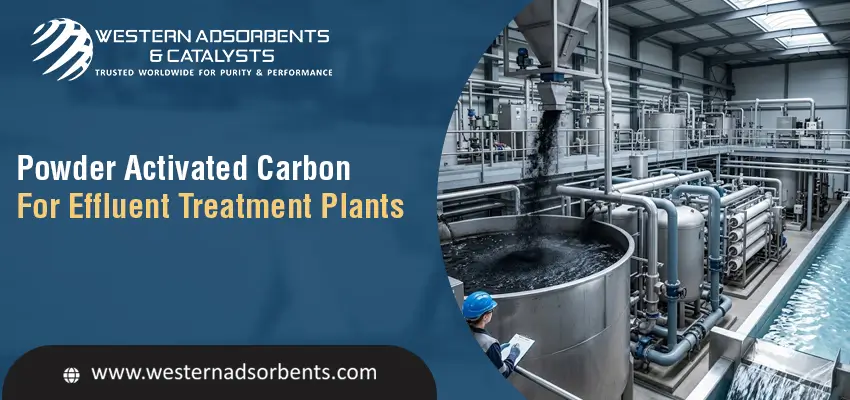
Effluent treatment plants (ETPs) are important components in industrial processes. These treatment plants effectively treat wastewater from industrial facilities to ensure environmental protection and compliance with regulatory standards. Activated carbon plays an important role in removing impurities like dissolved substances, heavy metals and salts. With exceptional adsorption capabilities, activated carbon is used in both water and wastewater treatment applications. Powder Activated Carbon (PAC) becomes a critical addition to the treatment train.
As one of India's leading activated carbon manufacturers, Western Adsorbents & Catalysts supplies PAC grades engineered specifically for effluent polishing, COD reduction, and protection of downstream biological and membrane systems.
Why Do ETPs Need Activated Carbon?
Most ETPs are designed around three stages: physical/chemical pre-treatment, biological treatment (activated sludge, MBBR, or MBR), and final polishing before discharge or reuse. Activated carbon plays a role at more than one of these stages because of its enormous internal surface area, typically 600 to 1100 m²/gm for PAC, which allows it to adsorb a wide range of dissolved contaminants that other processes can't remove efficiently.
- Colour & COD Reduction: Dyes, pigments, and dissolved organic compounds that contribute to high Chemical Oxygen Demand (COD) and colour are physically adsorbed onto the carbon's micro and meso-pores, helping plants meet CPCB colour and COD discharge limits.
- Protecting Biological Treatment: Certain industrial effluents contain compounds that are toxic or inhibitory to the microorganisms used in biological treatment. Dosing PAC ahead of or within the biological stage adsorbs these inhibitory compounds, buffering the biomass against shock loads and process upsets.
- Odour Control: PAC effectively adsorbs odour-causing volatile compounds, which is particularly valuable for tannery, pharmaceutical, and food processing effluents where odour complaints are a common compliance issue.
- Removal of Recalcitrant & Refractory Organics: Some organic compounds resist biological degradation entirely. PAC adsorbs these recalcitrant molecules, both reducing their concentration directly and, in combined biological-carbon systems, extending the time available for partial biological breakdown.
Read: Where is Activated Carbon Used in an RO Plant?
How PAC Work in an Effluent Treatment Plant?
The activated carbon suppliers in India deliver Powder activated carbon for effluent treatment, which is typically applied in one of the following configurations, depending on the effluent characteristics and plant design:
- Direct Dosing into the Equalisation or Aeration Tank: PAC is added as a slurry directly into the biological treatment tank, where it adsorbs organics while remaining in contact with the mixed liquor for an extended period. This is the approach used in Powdered Activated Carbon Treatment (PACT) systems, which combine biological degradation with adsorption in a single unit.
- Pre-treatment Dosing: PAC is dosed and mixed with the effluent before coagulation-flocculation, allowing adsorbed contaminants to settle out along with the chemical sludge in the clarifier.
- Tertiary/polishing Stage: PAC is used as a final polishing step after biological treatment, to remove residual colour, COD, and trace organics before discharge or before the water enters a reverse osmosis (RO) system for reuse.
Read: Activated Carbon Vs. Activated Alumina Balls
How to Choose the Right PAC Grade for Your ETP
Not all powder activated carbon performs the same way in wastewater applications. The right grade depends on the dominant contaminants in your effluent, your plant's pH conditions, and whether the carbon will be used in a biological tank or as a standalone polishing step.
| PAC Grade | Raw Material Use | Best Suited For |
| Unwashed PAC | Coconut shell, wood, coal | General colour, odour, and COD removal in biological tanks and pre-treatment dosing |
| Acid Washed PAC | Coconut shell | Polishing applications where minimal ash leaching is critical, and as RO membrane protection |
| Coal-based PAC | Bituminous/lignite coal | High-COD industrial wastewater, dechlorination, and large-scale municipal/industrial ETPs |
| Wood-based PAC | Pine wood, sawdust | Fine particle, fast-kinetics applications where rapid adsorption is needed in liquid-phase processes |
Get the Right PAC Grade for Your ETP Operations
Western Adsorbents & Catalysts, as one of the top activated carbon manufacturers in world produces powder activated carbon from coconut shell, wood, and coal with custom particle sizing and washing options available. Our technical team can help you select the right grade based on your effluent profile and discharge norms.
Frequently Asked Questions (FAQs)
1. Can PAC be added directly to an existing biological ETP without redesigning the plant?
In many cases, yes. PAC can be dosed into existing aeration tanks as part of a PACT-style retrofit, which is one of the reasons it's a popular option for plants needing to meet stricter discharge norms without a full redesign. The right dosing rate should be confirmed through jar testing on your specific effluent.
2. Does PAC replace the need for biological treatment?
No. PAC complements biological treatment rather than replacing it. It removes compounds that are toxic to or resistant against biological degradation, while the biological stage continues to handle the bulk of the organic load.
3. What's the difference between PAC and GAC for wastewater treatment?
PAC is used as a one-time dose that's removed with the sludge, making it suitable for variable or shock-load conditions. GAC is used in fixed beds and can be regenerated, making it more suitable for consistent, lower-flow polishing applications such as final effluent filters.
4. Which industries commonly use PAC in their ETPs?
PAC is widely used in textile, dye, chemical, pharmaceutical, distillery, tannery, and food processing effluent treatment, as well as in Common Effluent Treatment Plants (CETPs) handling mixed industrial wastewater.
5. What is Powder Activated Carbon (PAC) used for in effluent treatment plants?
Powder Activated Carbon (PAC) is used to remove colour, odour, COD, dissolved organics, and refractory contaminants from industrial wastewater, helping ETPs meet discharge standards.
6. How does PAC work in an effluent treatment plant?
PAC adsorbs dissolved contaminants onto its highly porous surface. It can be dosed into aeration tanks, pre-treatment systems, or tertiary polishing stages to improve wastewater quality.
7. Can PAC be added to an existing biological ETP?
Yes. PAC can often be introduced into existing aeration tanks as part of a PACT system without requiring major plant modifications. Jar testing is recommended to determine the optimal dosage.
8. Does PAC replace biological treatment?
No. PAC complements biological treatment by removing compounds that are difficult to biodegrade or harmful to microorganisms, improving overall treatment efficiency.
9. What is the difference between PAC and GAC?
PAC is a powdered form of activated carbon added directly into the treatment process and removed with sludge, while Granular Activated Carbon (GAC) is used in fixed-bed filtration systems and can be regenerated.
10. Which industries commonly use PAC in wastewater treatment?
PAC is widely used in textile, dye, pharmaceutical, chemical, distillery, tannery, food processing, and CETP wastewater treatment applications.
11. How do I choose the right PAC grade for my ETP?
The ideal PAC grade depends on wastewater composition, COD levels, colour, pH conditions, treatment objectives, and whether PAC will be used in biological treatment or polishing applications.