Reverse Osmosis (RO) plants are the backbone of modern water purification across industries from pharmaceuticals and food processing to municipal and industrial water treatment. However, the efficiency and longevity of an RO system are not determined solely by the membrane; it begins much earlier, at the pre-treatment stage.
This is where activated carbon plays a pivotal role. It acts as a critical safeguard, ensuring that contaminants harmful to RO membranes are effectively removed before filtration. High-quality solutions from leading activated carbon manufacturers in world, like Western Adsorbents & Catalysts, are specifically engineered to deliver consistent adsorption performance in demanding water treatment environments.
Complete RO Plant Process Flow Explained
To fully understand the placement of activated carbon, let’s examine a typical RO plant workflow:
- Raw Water Intake: Source water containing suspended solids, chlorine, and organics
- Pre-Treatment Stage
- Sand filtration (removes suspended particles)
- Activated carbon filtration (removes chlorine & organics)
- Softening or anti-scalant dosing
- High-Pressure Pumping
- RO Membrane Filtration – Removes dissolved salts and impurities
- Post-Treatment
- UV/ozonation
- Activated carbon polishing (optional)
- Storage & Distribution
From this sequence, it’s clear that activated carbon is strategically placed before and sometimes after the RO membrane.
Where is Activated Carbon Used in an RO Plant?
#1 Pre-treatment Stage (Primary Application)
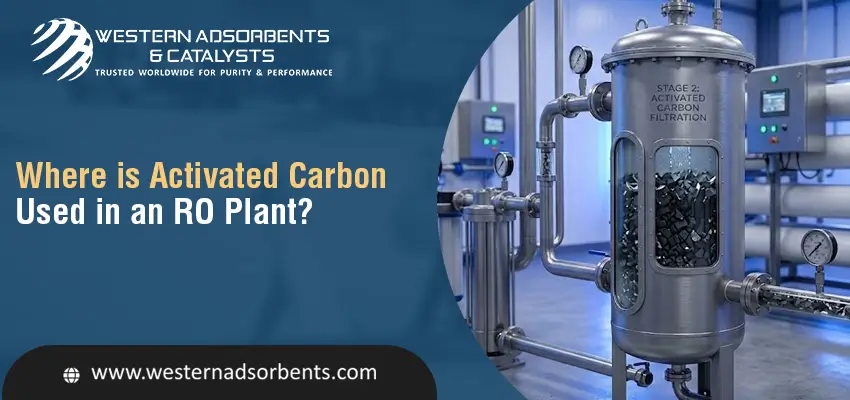
The most critical application of activated carbon is in the Activated Carbon Filter (ACF) positioned before the RO membranes. This stage is essential because RO membranes are highly sensitive to oxidizing agents and organic fouling. Activated carbon ensures that these harmful elements are removed effectively.
#2 Intermediate Applications (Advanced Systems)
In complex industrial setups, activated carbon may also be used between treatment stages to:
- Remove residual chemicals
- Improve feed water consistency
- Enhance system stability
#3 Post Treatment
In applications requiring high-quality output, such as drinking water, pharmaceuticals, or food processing, businesses rely on coconut shell activated carbon manufacturer in India to:
- Improve taste and odour
- Remove trace organics
- Deliver final polishing
Role of Activated Carbon in Pre-Treatment in RO Plants
#1 Removal of Chlorine & Oxidants
Chlorine is widely used for disinfection, but it is highly destructive to RO membranes. Even small concentrations can degrade membrane material through oxidation. Activated carbon removes chlorine via adsorption and catalytic reduction, making it indispensable for membrane protection.
#2 Adsorption of Organic Compounds
Water often contains organic contaminants like pesticides, industrial solvents, natural organic matter (NOM) and other unwanted substances. Activated carbon’s porous structure provides a large surface area, enabling it to trap these compounds effectively.
#3 Improves Colour, Taste & Odour
In applications where water quality impacts user experience, the manufacturer of activated charcoal in India offers activated carbon to remove:
- Unpleasant odors
- Colour-causing compounds
- Volatile organic compounds (VOCs
#4 Protection of RO Membranes
RO membranes are expensive and sensitive. Without proper carbon filtration:
- Fouling increases
- Membrane life decreases
- Maintenance costs rise
Activated carbon acts as a first line of defence, ensuring stable and efficient system performance.
Conclusion
Activated carbon is not just a supporting component; it is a core element of any efficient RO plant design. Its strategic placement in pre-treatment and post-treatment stages ensures optimal water quality, protects critical components, and enhances system longevity. By choosing high-performance solutions from Western Adsorbent, one of the top activated carbon suppliers in India, industries can achieve reliable, efficient, and cost-effective water treatment outcomes. To discuss your activated carbon needs, call us today.