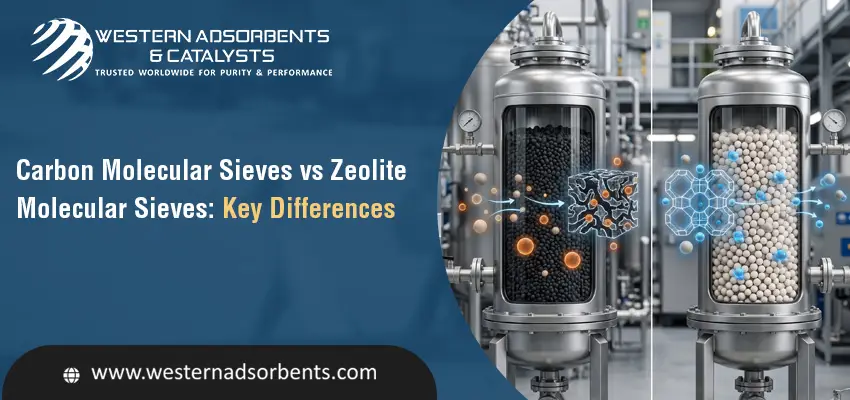
When it comes to carbon molecular sieves and zeolite molecular sieves, they have similar names, but they are different materials. They have different structures, adsorption properties, and applications. Choosing between them is not simply a matter of preference. The right choice depends on which gas you need to separate, the operating conditions, and the performance you expect. This guide explains the key differences between carbon molecular sieves and zeolite molecular sieves and helps you determine which one is better suited to your application.
Carbon Molecular Sieves vs Zeolite Molecular Sieves: Key Glance
| Factor | Carbon Molecular Sieves | Zeolite Molecular Sieves |
| Material | Carbon-based, pore-tuned | Crystalline aluminosilicate |
| Structure | Amorphous carbon with engineered micropores | Rigid, uniform crystalline pores |
| Seperation | Kinetic- differences in diffusion rate | Equilibrium, size exclusion plus polarity |
| Surface character | Hydrophobic, non-polar | Hydrophilic, polar |
| Air separation output | Nitrogen | Oxgyen |
| Signature uses | On-site N₂ generation | Drying, CO₂/H₂S removal, O₂ generation |
Carbon Molecular Sieves vs Zeolite Molecular Sieves: Difference in Working Mechanism
The biggest difference between carbon molecular sieves (CMS) and zeolite molecular sieves is how they separate molecules.
How Carbon Molecular Sieves Work?
Carbon molecular sieves separate gases mainly through kinetic separation. Their carefully controlled pore structure allows smaller, faster-moving molecules to diffuse into the pores more quickly than larger, slower-moving molecules. The separation therefore depends largely on the rate of diffusion during a short adsorption cycle. This is why CMS is widely used in fast-cycling PSA nitrogen generation. In compressed air, oxygen enters the CMS pores more rapidly, while nitrogen passes through more readily, resulting in nitrogen-rich product gas.
How Molecular Sieves Work?
Zeolite molecular sieves, on the other hand, rely more strongly on equilibrium adsorption and molecular affinity. Their crystalline pore structure allows molecules of suitable size to enter, while their internal surface has a strong affinity for certain polar and quadrupolar molecules such as water and CO₂. With sufficient contact time, adsorption is governed largely by the relative affinity of the molecules for the zeolite surface.
The choice between CMS and zeolite should be based on your target gas, separation mechanism, PSA cycle, operating conditions, and required purity and flow rate. Western Adsorbents & Catalysts is a trusted carbon molecular sieve and molecular sieve manufacturer in India, supplying high-quality adsorbents designed for demanding gas separation and purification applications.
Performance Parameters
➤ Selectivity: Selectivity indicates how effectively the adsorbent distinguishes one molecule from others in the gas stream. Better selectivity can help achieve higher product purity while reducing the loss of the desired gas.
➤ Adsorption Kinetics and Cycle Time: CMS is particularly suited to rapid PSA cycles, where differences in diffusion rates drive separation. Zeolites used for applications such as gas drying may operate with different cycle times. The adsorbent and PSA cycle therefore need to be designed to work together.
➤ Mechanical Strength & Attrition Resistance: Molecular sieve beds undergo repeated pressurisation, depressurisation, and regeneration. Good mechanical strength helps the particles withstand these cycles, while high attrition resistance reduces dust formation and helps protect downstream equipment.
➤ Bulk Density & Packing: Bulk density determines how much adsorbent can be loaded into a vessel of a given size. This affects the adsorption capacity available per unit of bed volume and can influence equipment sizing.
Energy & Regeneration: PSA, VSA & TSA
Carbon molecular sieves (CMS) are commonly regenerated through pressure swing adsorption (PSA). During the cycle, the bed is pressurised with compressed air, allowing oxygen to adsorb more quickly. The pressure is then reduced to release the adsorbed oxygen and regenerate the CMS before the next cycle. The carbon molecular sieves manufacturers in India recommends CMS is well suited to continuous and automated nitrogen generation.
Molecular sieves can use different regeneration methods depending on their application. For air and gas drying, thermal swing adsorption (TSA) is commonly used. Heat is applied to remove the water adsorbed by the zeolite, after which the bed is cooled and prepared for the next cycle. TSA can provide effective regeneration but generally requires additional thermal energy and longer cycles.
Applications across Industries
Carbon molecular sieves, nitrogen generation for:
➤ Food and beverage packaging and modified-atmosphere preservation
➤ Electronics and semiconductor manufacturing
➤ Metal heat treatment and laser cutting
➤ Pharmaceutical and laboratory inert atmospheres
Zeolite molecular sieves, drying, purification, and oxygen for:
➤ Compressed air and process gas drying
➤ Natural gas dehydration and sweetening (removing water, CO₂, and H₂S)
➤ Refrigerant and solvent drying
➤ Ethanol and solvent dehydration
➤ Insulating glass units (moisture control between panes)
➤ Medical and industrial oxygen generation
Choose the Right Molecular Sieve With Western Adsorbents & Catalysts
Carbon and zeolite molecular sieves are designed for different separation requirements. The right choice depends on the target molecule, feed composition, operating conditions, regeneration method, and the performance you need from the system. Choosing the correct adsorbent can improve separation efficiency, product purity, energy performance, and adsorbent life. As a carbon molecular sieves supplier in India, Western Adsorbents & Catalysts offers high-quality molecular sieve solutions for gas separation, purification, and drying applications. Not sure whether your application requires a carbon molecular sieve, a molecular sieve, or a combination of both? Talk to the Western Adsorbents team today.