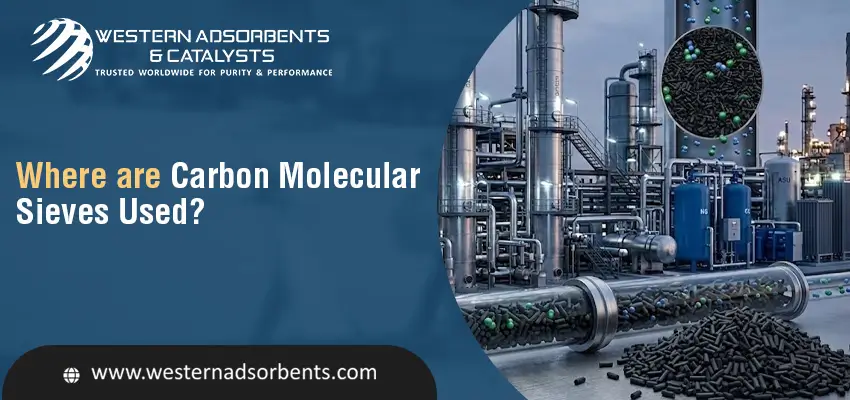
Across petrochemicals, food packaging, electronics manufacturing, and healthcare, one invisible challenge connects them all: the need for pure, dry, inert gas, reliably, continuously, and cost-effectively. Carbon Molecular Sieves (CMS) are the material that makes this possible at an industrial scale. Yet despite being a critical component inside PSA nitrogen generators and gas separation systems worldwide, CMS remains surprisingly misunderstood outside engineering circles.
How CMS Works: The PSA Cycle Step by Step
The most important application of CMS is in Pressure Swing Adsorption (PSA) systems for nitrogen generation. Understanding how PSA works helps explain why CMS quality and consistency are so critical to system performance.
- Pressurisation: Compressed air enters the CMS-filled adsorber vessel. Pressure rises to 0.75–0.8 MPa.
- Adsorption: Oxygen, CO₂ and moisture diffuse rapidly into CMS pores. Nitrogen diffuses more slowly as product gas.
- Depressurisation: Pressure drops. Adsorbed oxygen is released from the CMS pores back into the exhaust stream.
Read: What are Molecular Sieves?
PSA systems typically operate two vessels in alternating cycles, so one is always adsorbing while the other regenerates. This continuous switching often occurs every 30 to 60 seconds. This is why industries rely on trusted carbon molecular sieves suppliers in India for mechanical durability and consistent pore structure for reliable nitrogen output.
Key Technical Specifications
| Property | Specification |
| Appearance | Cylindrical extruded, black solid |
| Diameter | 1.1 – 1.3 mm |
| Pore Size Distribution | 3 – 5 Angstroms (slit-shaped micropores) |
| Microporous Volume | 0.15 – 0.25 cm³/g |
| Surface Area | 250 – 400 m²/g |
| Bulk Density | 680 – 700 kg/m³ |
| Crushing Strength | 80 – 90 kg/cm² |
| Adsorption Pressure | 0.75 – 0.8 MPa |
| CTC Activity | 30% – 40% |
| Operating Temperature | Below 0 °C to 500 °C |
Popular Carbon Molecular Sieves Applications
- PSA & VSA Nitrogen Systems: The primary application, CMS enables on-site N₂ production from compressed air at purities from 95% to 99.999%, eliminating dependence on delivered liquid nitrogen.
- Inert Atmosphere Packaging: Nitrogen flushes oxygen from packaging, extending the shelf life of perishable foods, coffee, snacks, and beverages
- Heat Treatment of Metals: CMS-generated nitrogen provides the inert blanket required during annealing, sintering, and brazing to prevent oxidation.
- Biogas Upgrading: CMS removes CO₂, moisture and trace contaminants from raw biogas, upgrading it to pipeline-quality biomethane.
- Hydrogen Purification: CMS adsorbs water, hydrocarbons and CO₂ from H₂ streams to produce high-purity hydrogen for fuel cells and chemical processes.
Why Western Adsorbents & Catalysts for CMS
Western Adsorbents & Catalysts is the leading carbon molecular sieves manufacturer to industrial buyers across India and globally. Their CMS is engineered for PSA and VSA nitrogen systems, gas separation, air purification, biogas upgrading, and hydrogen purification with consistent pore structure and mechanical properties verified through in-house testing for every production batch. For the best quotes, call us today.