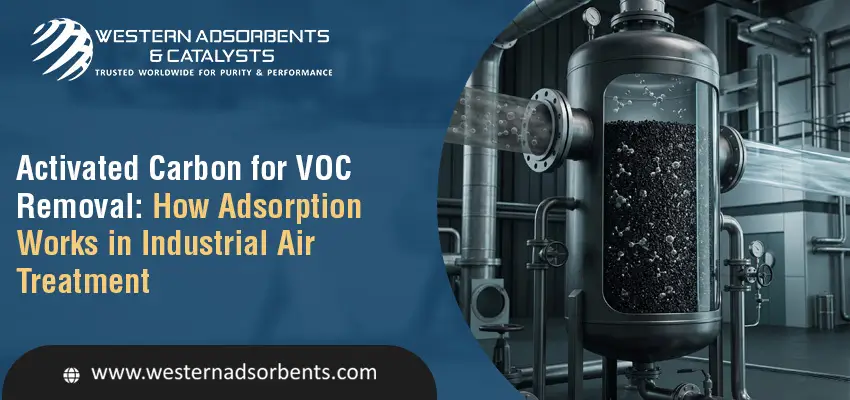
When VOCs enter an industrial air stream, effective control depends on more than simply passing the air through a filter. The right adsorbent, operating conditions, and contact time all determine how efficiently those compounds are captured.
Volatile organic compounds (VOCs) are released during processes such as solvent handling, coating, printing, chemical manufacturing, fuel storage, and petrochemical operations. Because many VOCs readily evaporate into the air, industrial facilities need treatment systems designed around the specific contaminants and operating conditions.
Western Adsorbents & Catalysts provides activated carbon solutions for industrial adsorption applications, where carbon selection is based on factors such as contaminant characteristics, pore structure, and process conditions.
What Happens When VOC-Loaded Air Meets Activated Carbon?
Activated carbon removes VOCs primarily through adsorption. As contaminated air passes through a carbon bed, VOC molecules move from the gas stream toward the surface of the carbon particles and then into their pore structure.
The extensive internal surface area of activated carbon provides numerous sites where organic molecules can be retained.
The process can be simplified as:
VOC-containing air → mass transfer → pore diffusion → adsorption → treated air
However, adsorption does not continue indefinitely. As the carbon captures VOCs, the available adsorption sites gradually become occupied. Eventually, contaminants begin moving through the bed, creating a breakthrough condition.
Why VOC Type Matters
Different VOCs do not interact with activated carbon in exactly the same way. Molecular size, polarity, concentration, vapour pressure, and boiling point can influence how strongly a compound is adsorbed.
This is why carbon selection should begin with identifying the actual VOC mixture rather than choosing a grade based only on its surface area.
For example, a manufacturer of activated charcoal may offer several carbon grades, but their suitability can vary significantly depending on the contaminant and the air-treatment conditions.
Humidity Can Change Adsorption Performance
Water vapour is an important consideration in industrial VOC treatment.
Under humid conditions, water molecules can compete with certain VOCs for available adsorption sites and influence how contaminants move through the carbon bed. The effect depends on the carbon's pore structure, surface characteristics, and the VOC being treated.
For systems operating with consistently high humidity, industries should therefore consider moisture conditions when selecting the carbon grade and designing the treatment bed.
Temperature and Contact Time Matter
Temperature can influence the balance between adsorption and desorption. For many VOCs, adsorption onto activated carbon is generally more favourable at lower temperatures. Higher temperatures can reduce adsorption capacity and may encourage previously adsorbed
molecules to leave the carbon surface.
Contact time is equally important.
If contaminated air moves through the bed too quickly, VOC molecules may not have sufficient time to transfer into the carbon pores. Bed depth, airflow rate, particle size, and system configuration must therefore be considered together.
Choosing Carbon for an Industrial VOC System
The correct carbon is not necessarily the one with the highest advertised surface area.
Companies comparing granular activated carbon suppliers should evaluate particle size, pore-size distribution, mechanical strength, moisture content, adsorption characteristics, and the expected operating environment.
The raw material used to produce the carbon can also influence its pore structure. When evaluating coconut shell activated carbon suppliers, buyers should consider whether the resulting microporous characteristics are suitable for the target VOCs rather than selecting solely on the basis of carbon origin.
An experienced Activated Carbon Manufacturer in Afghanistan should be able to connect these material characteristics with the actual requirements of the air-treatment system.
How Do You Know When Carbon Is Approaching Saturation?
A carbon bed does not suddenly stop working. Adsorption progresses through the bed as the carbon becomes increasingly loaded with VOCs.
The leading edge of adsorption gradually moves through the bed, creating a mass transfer zone. Once VOCs begin appearing at the outlet, the system may be approaching a breakthrough.
Monitoring outlet VOC concentration can therefore provide a more reliable indication of carbon replacement requirements than following an arbitrary calendar-based replacement schedule.
Where Does CMS Fit Into VOC Treatment?
Carbon molecular sieve and activated carbon are both carbon-based adsorbents, but they are designed for different separation purposes.
A carbon molecular sieves supplier in India typically supplies CMS products engineered around controlled pore structures for selective gas separation. Their primary applications differ from conventional activated carbon systems used for broad VOC adsorption.
Similarly, a Molecular Sieves exporter may supply zeolitic materials used for drying and selective adsorption. Their suitability for VOC removal depends on the specific compound and process conditions.
The adsorbent should therefore always be selected according to the separation requirement rather than treating different materials as interchangeable.
Designing a More Reliable VOC Adsorption System
Before selecting an activated carbon grade, an industrial facility should establish:
➤ VOC type and concentration
➤ Airflow rate
➤ Temperature
➤ Relative humidity
➤ Required removal efficiency
➤ Carbon particle characteristics
➤ Bed depth and contact time
➤ Expected breakthrough behavior
➤ Replacement or regeneration requirements
These parameters help determine whether the selected carbon can provide the required treatment performance under actual operating conditions.
Western Adsorbents & Catalysts approaches activated carbon selection around the relationship between material properties and application requirements, rather than relying on a single performance specification.
Conclusion
Activated carbon can provide effective VOC control, but successful adsorption depends on the interaction between carbon properties and operating conditions. VOC characteristics, humidity, temperature, airflow, contact time, and breakthrough behaviour should all be considered when designing an industrial treatment system.
Western Adsorbents & Catalysts can help industries evaluate activated carbon requirements according to their specific VOC treatment conditions. Instead of selecting carbon solely by surface area or price, reviewing the contaminant profile and operating parameters first provides a stronger basis for choosing the appropriate adsorption solution.
FAQs
How does activated carbon remove VOCs?
Activated carbon removes VOCs mainly through adsorption. Organic molecules move from the air stream into the carbon's porous structure and are retained on internal surfaces.
Does humidity affect VOC adsorption?
Yes. Water vapour can compete with some VOC molecules for adsorption sites and influence mass transfer through the carbon bed.
Is granular activated carbon suitable for VOC removal?
Yes. Granular activated carbon is commonly used in packed-bed air-treatment systems, provided the grade and particle characteristics are appropriate for the target VOCs and operating conditions.
When should activated carbon be replaced?
Replacement should ideally be based on adsorption loading and breakthrough monitoring. The actual interval depends on VOC concentration, airflow, temperature, humidity, carbon capacity, and system design.