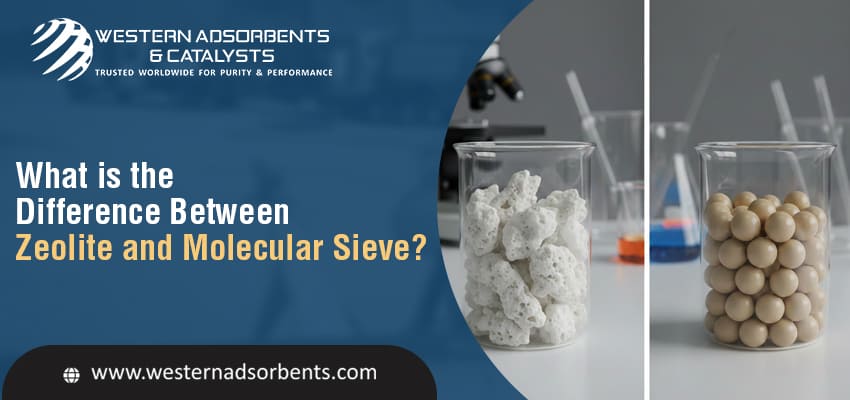
Zeolite and molecular sieves are often used interchangeably in industrial discussions. While they are closely related, they are not exactly the same. In fact, a molecular sieve is a type of zeolite engineered for precise molecular separation. Understanding the difference between these two adsorbent materials is important when selecting the right solution for your industrial application. Let’s explore how they differ.
Discovery of Molecular Sieves
The concept of molecular sieving was introduced by J.W. McBain in 1932. Molecular sieves are highly porous crystalline materials designed to separate molecules based on size and polarity. They function at a microscopic level, allowing smaller molecules to enter their pores while excluding larger ones.
Molecular sieves are typically synthetic zeolites manufactured with precise pore sizes such as 3A, 4A, 5A, and 13X. These pore sizes are engineered for specific industrial applications, including gas drying, air separation, solvent dehydration, and hydrocarbon processing.
Western Adsorbents & Catalysts is a trusted molecular sieves manufacturer in India, offering high-performance molecular sieves in grades 3A, 4A, 5A, and 13X tailored to diverse industrial requirements.
Discovery of Zeolite
Zeolite is a naturally occurring crystalline mineral composed mainly of hydrated aluminosilicates. It was discovered in 1756 by Swedish mineralogist A.F. Cronstedt, who observed that when natural aluminosilicate minerals were heated, they released steam as if they were boiling. He named the material “zeolite,” derived from the Greek words zeo (to boil) and lithos (stone).
Zeolites are known for their uniform microporous structure, which allows them to trap and release molecules. Over time, synthetic zeolites were developed to provide more controlled pore sizes and improved performance in industrial processes such as catalysis, ion exchange, and adsorption.
Difference Between Zeolite and Molecular Sieve
Although related, there are clear distinctions between zeolite and molecular sieve:
Classification
Zeolite refers to a broad class of naturally occurring or synthetic aluminosilicate minerals defined by their chemical and physical properties.
A molecular sieve, on the other hand, is defined by its function and pore size precision. It is specifically engineered to separate molecules based on size exclusion and adsorption behaviour.
In simple terms, all molecular sieves are zeolites, but not all zeolites function as molecular sieves.
Chemical Composition
Zeolite typically consists of sodium, potassium, or calcium aluminosilicate structures.
Molecular sieves are crystalline silicates or aluminosilicates with carefully controlled silica-to-alumina ratios. This ratio influences adsorption strength, thermal stability, and selectivity.
Modern molecular sieves may also be modified with cations such as potassium or calcium to achieve specific pore sizes (e.g., 3A or 5A).
Characteristics
Zeolite:
➤ Glass-like appearance
➤ Microporous structure
➤ Ability to reabsorb water and other liquids
➤ Ion exchange capability
Molecular Sieve:
➤ Highly uniform pore structure
➤ High adsorption capacity
➤ Excellent thermal stability
➤ Strong affinity for water and polar molecules
➤ Effective at very low moisture levels (ppm range)
Molecular sieves are particularly effective in critical drying applications where extremely low dew points are required.
Unique Properties
➤ Molecular sieves typically have:
➤ Relative density between 2.0 and 2.8
➤ Hardness ranging from 3 to 5 on the Mohs scale
➤ High crush strength for industrial packed beds
➤ Ability to withstand regeneration cycles at high temperatures
Zeolites are insoluble in water and show excellent resistance to heat and acids, especially when silica content increases. However, natural zeolites may have variations in purity and pore size compared to synthetic molecular sieves.
Industrial Applications
➤ Zeolites are widely used in:
➤ Detergents
➤ Soil conditioning
➤ Water softening
➤ Catalytic cracking
Molecular sieves are used in more precision-driven industries, such as:
➤ Natural gas drying
➤ Air separation units
➤ Petrochemical refining
➤ Refrigeration systems
➤ Pharmaceutical solvent dehydration
➤ Oxygen and nitrogen generation
Because of their controlled pore sizes and superior adsorption properties, molecular sieves are preferred where exact separation is required.
Conclusion
Zeolite and molecular sieves share a common structural foundation, but their purpose and performance differ significantly. Zeolite is a broad mineral category, while molecular sieves are engineered materials designed for precise molecular separation. Understanding these differences helps industries select the right adsorbent for efficient performance and long-term reliability.
Western Adsorbents & Catalysts is a leading molecular sieves supplier in India, offering a comprehensive range of high-quality molecular sieves for industrial applications. With advanced manufacturing capabilities and application-specific solutions, Western Adsorbents ensures consistent performance and dependable supply.
For more information about selecting the right molecular sieve for your process, connect with our technical team today.