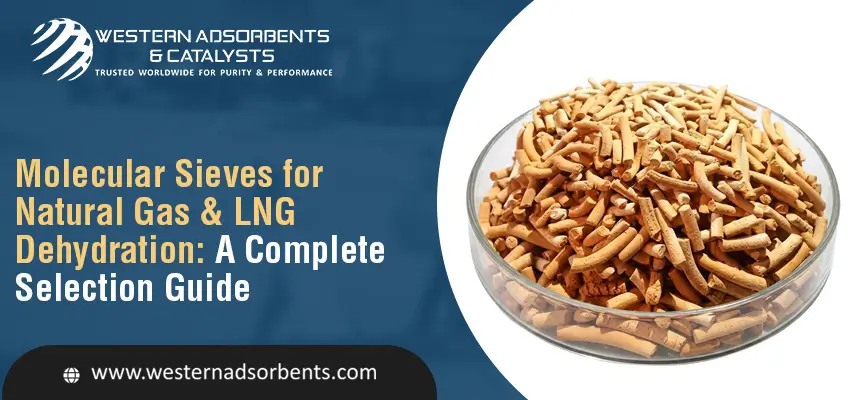
Water is a major threat to natural gas pipelines and LNG facilities. Even tiny amounts of moisture can form hydrate plugs, corrode equipment, and disrupt processing operations. For gas treatment plants and LNG units, effective dehydration is essential for safe and reliable performance. Molecular sieves are the preferred solution for deep dehydration. Unlike glycol systems, they can reduce moisture levels to below 0.1 ppm and operate reliably under high pressure and varying temperatures, while being regenerable for long-term use.
However, selecting the right molecular sieve is critical. Factors like pore size, sieve grade, bed design, and regeneration method must match the gas composition and process conditions. Choosing the wrong sieve can increase costs and reduce efficiency.
This guide explains how to choose the right molecular sieve for natural gas and LNG dehydration systems.
Why Natural Gas and LNG Dehydration Demands More Than Standard Drying
Natural gas at the wellhead is almost always saturated with water vapour. As the gas is compressed and transported, that moisture becomes a series of escalating problems:
➤ Hydrate Formation: At high pressure and low temperature, water reacts with hydrocarbons to form solid gas hydrates that block pipelines and equipment.
➤ Corrosion: Moisture combined with CO₂ or H₂S forms acids that accelerate steel corrosion.
➤ Liquid Water Dropout: Free water in gas streams can cause pipeline slugging and compressor damage.
➤ LNG Specification Failure: LNG processes operate below -160°C, so even trace moisture can freeze and block cryogenic equipment, making <0.1 ppm water content essential.
Standard drying technologies like silica gel or glycol contactors cannot reliably achieve these dew points under industrial operating conditions. This is when molecular sieves enter. Industries rely on molecular sieves manufacturers in India for these sieves with their crystalline zeolite structure and precisely defined pore sizes. These properties allow removable water molecules from a gas stream to the levels that LNG and deep pipeline drying require.
Key Industry Specification
According to the GPSA Engineering Data Book and Kohl & Nielsen’s Gas Purification, pipeline gas typically requires water dew points between −10°C and −20°C, while LNG feed gas must contain less than 0.1 ppmv water to prevent freezing in cryogenic equipment. Molecular sieve adsorption is the only widely used single-stage technology capable of consistently achieving this specification.
How Molecular Sieves Work in Gas Dehydration
➤ Stage 1: Molecular sieves are synthetic zeolites, crystalline aluminosilicate materials with a three-dimensional pore structure of precisely uniform diameter. This uniformity is what distinguishes them from amorphous adsorbents like silica gel or activated alumina, which have a distribution of pore sizes.
➤ Stage 2: In a gas dehydration unit, the wet gas is passed downward through a fixed bed of molecular sieve beads or pellets under pressure. Water molecules — small enough to enter the pore structure are adsorbed onto the internal surface of the sieve by a combination of electrostatic forces and van der Waals interactions. Larger hydrocarbon molecules cannot enter the pores and pass through the bed unaffected.
➤ Stage 3: Once the bed reaches capacity (breakthrough), the adsorber is taken offline and regenerated. A stream of hot, dry gas, typically at 250°C to 320°C is passed through the bed in the reverse direction, driving the adsorbed water out of the pores. After cooling with a slip of dry gas, the bed is returned to service.
Most industrial installations use a two-bed or three-bed configuration, allowing continuous operation: one bed adsorbs while the other regenerates.
Selecting the Right Molecular Sieve Grade for Your Application
The most critical selection decision is the molecular sieve type defined by its pore diameter, expressed in Angstroms (Å). Molecular sieves for natural gas and LNG dehydration, the two primary grades are 3A and 4A, with 5A used in applications that require simultaneous removal of CO₂ or H₂S alongside water.

3A Molecular Sieve: The Preferred Choice for LNG Dehydration
For LNG feed gas dehydration, 3A molecular sieve is widely preferred because its 3 Å pore size allows water molecules (2.65 Å) to enter while excluding larger hydrocarbons like ethylene and ethane. This selective adsorption prevents hydrocarbons from competing with water for adsorption sites, maintaining higher water capacity and more efficient regeneration compared to 4A sieves.
Key advantages of 3A molecular sieves in LNG applications:
➤ Achieves ultra-low dew points below −70°C, meeting LNG feed specifications
➤ Reduces hydrocarbon co-adsorption, lowering regeneration energy needs
➤ Minimizes risk of hydrocarbon cracking during high-temperature regeneration
➤ Provides longer service life in hydrocarbon-rich gas streams.
As a trusted molecular sieves manufacturer in India, Western Adsorbents & Catalysts supplies 3A molecular sieves in both bead and pellet forms, with diameters of 1.5 mm, 2–4 mm, and 3.3 mm to match vessel internals and pressure drop requirements.
4A Molecular Sieve: The Standard for Pipeline Gas Dehydration
For pipeline gas dehydration, where the goal is meeting water dew points of −10°C to −20°C, the 4A molecular sieve is the most commonly used option. Its 4 Å pore size efficiently adsorbs water and can also remove small amounts of carbon dioxide, ammonia, and sulfur dioxide when present. The 4A sieve is widely used in standard gas processing applications such as gathering stations, compression stations, and LPG dehydration. Its strong water adsorption capacity, durability, and long service life make it a cost-effective solution when ultra-low moisture levels are not required.
Selection Note: In gas streams with high levels of heavier hydrocarbons (C3+), 4A sieves may co-adsorb these molecules. During regeneration, they can crack and form carbon deposits (coking), which reduces adsorption capacity. In such cases, 3A molecular sieves are often preferred.
5A Molecular Sieve: When You Need to Remove More Than Water
The 5A molecular sieve, with a 5 Å pore size, adsorbs water along with normal paraffins up to C4, as well as carbon dioxide and hydrogen sulfide. This makes it useful in processes where dehydration and limited acid gas removal are required in a single adsorption bed. Common applications include biogas upgrading (removal of H₂S and water), small-scale LNG systems, and hydrogen purification. As a certified molecular sieves supplier in India, W.A.C. supplies 5A sieves in 1.6 mm, 2.4 mm, and 3–5 mm sizes for both laboratory and industrial applications.
Conclusion
Molecular sieves are the definitive solution for natural gas and LNG dehydration, but their performance depends entirely on selecting the right grade, specifying the correct technical parameters, and sourcing from a supplier who understands the application. For LNG feed gas, 3A is the clear technical choice. For pipeline dehydration, 4A delivers reliable, cost-effective performance. For applications requiring simultaneous acid gas removal, 5A offers an efficient combined solution.
Correct regeneration design is as important as sieve selection. Bed temperatures, regeneration gas quality, flow direction, and cooling all determine how long your sieve investment lasts and how consistently your plant meets its dew point specification.
Need Molecular Sieves for Your Gas Dehydration Project?
Western Adsorbents & Catalysts supplies 3A, 4A, 5A, and 13X molecular sieves in bead and pellet form, with full technical documentation and application support. Our team can help you select the correct grade and form for your specific gas composition and process conditions.