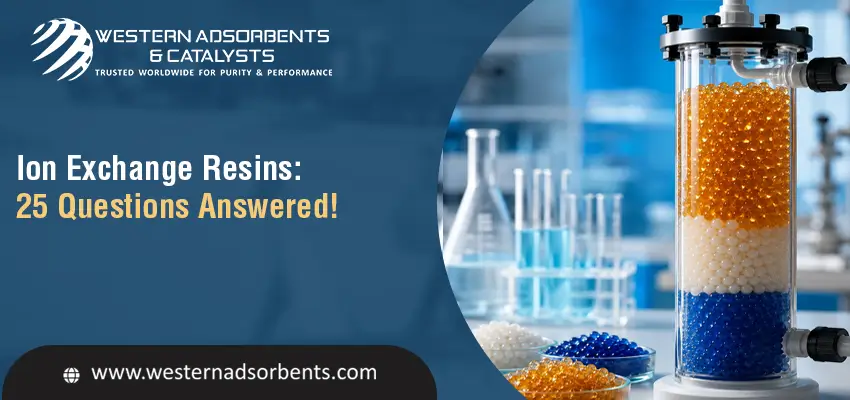
Ion exchange resins play an important role in softening, demineralization, metal recovery and countless purification processes, yet most questions about them come down to a few practical basics. Here are 25 of the most common ones, answered about ion exchange resins.
What are Ion Exchange Resins?
Ion exchange resins are polymer beads that remove unwanted dissolved ions from water by exchanging them with harmless ions. They are widely used in water softening, demineralization, ultrapure water production, metal recovery, and industrial purification processes.
The Basics: Understanding Ion Exchange Resins
1. What is an ion exchange resin?
➤ It's a small, insoluble polymer bead carrying fixed charged groups that swap ions with a passing liquid, trading unwanted ions for harmless ones without dissolving or changing the resin itself.
2. What is ion exchange?
➤ A reversible swap of one ion in a solution for another ion of the same charge held on a solid. It's the principle behind water softening, demineralization and many separation processes.
3. How does an ion exchange resin work?
➤ Water flows through a bed of resin beads. The fixed functional groups on the beads grab target ions from the water and release their own loosely held ions in exchange. When the beads fill up, they're regenerated and reused.
4. What is ion exchange resin made of?
➤ The ion exchange resin manufacturers in India usually make these resins of cross-linked polystyrene (styrene with divinylbenzene) or acrylic beads, chemically modified to carry charged functional groups such as sulfonic acid, carboxylic acid or amine groups.
5. What is ion exchange capacity?
➤ The measure of how many ions a given amount of resin can hold and exchange, usually expressed in equivalents per litre or per gram. Higher capacity means more water treated between regenerations.
Types & Structure: Ion Exchange Resin Types
6. What are the main types of ion exchange resins?
➤ Four, split by functional group: Strong Acid Cation (SAC), Weak Acid Cation (WAC), Strong Base Anion (SBA) and Weak Base Anion (WBA).
7. What's the difference between cation and anion resins?
➤ Cation resins carry a negative charge and capture positively charged ions (like calcium and magnesium). Anion resins carry a positive charge and capture negatively charged ions (like chloride, sulfate and nitrate).
8. What are Strong Acid Cation (SAC) resins?
➤ Polystyrene resins with sulfonic acid groups that work across the full pH range. They're the workhorse for water softening and the first stage of demineralization.
9. What are Weak Acid Cation (WAC) resins?
➤ Acrylic resins with carboxylic acid groups and a strong affinity for hardness linked to alkalinity. They regenerate very efficiently, making them ideal for dealkalization and high-hardness streams.
10. What are Strong Base Anion (SBA) resins?
➤ Polystyrene resins with quaternary amine groups that remove anions across all pH levels, including weakly ionized ones like silica and carbon dioxide. Essential for full demineralization.
11. What are Weak Base Anion (WBA) resins?
➤ Resins with weaker amine groups that absorb strong mineral acids (chloride, sulfate, nitrate). They regenerate efficiently and are often paired ahead of SBA resins in demineralization trains.
12. What is a mixed-bed resin?
➤ A blend of cation and anion resins in one vessel. Because water contacts both resins together, it produces very high-purity, deionized water used for polishing and ultrapure applications.
13. What's the difference between gel and macroporous resins?
➤ Gel resins have a dense structure, higher capacity and lower cost. Macroporous resins have a genuinely porous structure that resists fouling and osmotic shock, suited to tougher, organic-laden or high-purity duties.
Performance & Handling
14. What is regeneration?
➤ Once a resin is loaded with captured ions ("exhausted"), a concentrated regenerant solution is run through it to strip those ions off and recharge the beads, restoring capacity so the resin can be used again.
15. How is each resin type regenerated?
➤ SAC with a strong acid (or brine for softening), WAC with acid, and SBA and WBA with caustic soda (NaOH). Regeneration typically involves a backwash, chemical injection and rinse.
16. How long do ion exchange resins last?
➤ In water treatment, cation resins often last around 10–15 years and anion resins about 4–8 years. Actual life depends on water quality, temperature, fouling and how well regeneration is managed.
17. What factors affect ion exchange performance?
➤ Resin type and particle size, water pH and temperature, ionic strength, flow rate, and the regeneration method. Fouling from iron, organics or suspended solids also reduces capacity over time.
18. How should ion exchange resins be stored?
➤ Keep them indoors, out of direct sunlight, and protected from freezing and from drying out, typically below about 40 °C. Resins should stay moist to preserve capacity and bead integrity.
19. Are ion exchange resins hazardous?
➤ The resins themselves are generally inert and safe to handle. Dry resin can be dusty and irritating, and used resin may hold whatever contaminants it captured, so spent resin should be handled per its application.
Ion Exchange Resins Applications
20. What are the main applications of ion exchange resins?
➤ Water softening, demineralization and ultrapure water; metal recovery in mining and hydrometallurgy; catalysis in chemical reactions; and purification in food, beverage and pharmaceutical processing.
21. How do resins soften hard water?
➤ A sodium-charged cation resin swaps its sodium ions for the calcium and magnesium that cause hardness. When the resin is saturated, a salt (brine) rinse recharges it with fresh sodium.
22. What's the difference between deionization and demineralization?
➤ They're closely related: both use cation and anion resins to strip nearly all dissolved ions and produce high-purity water. "Demineralization" is the common term in industrial water treatment.
23. What does cation resin remove?
➤ Positively charged ions hardness-causing calcium and magnesium, plus heavy metals such as lead, copper and mercury in purification duties.
24. What does anion resin remove?
➤ Negatively charged ions like chloride, sulfate, nitrate, fluoride, arsenic and silica among them. Strong base anion resins also help remove certain organics and reduce alkalinity.
25. How do I choose the right ion exchange resin?
➤ Match the resin to the job: identify the ions you need to remove, then weigh exchange capacity, resin type (SAC/WAC/SBA/WBA), gel or macroporous structure, regeneration efficiency and your water chemistry. When in doubt, consult an ion exchange resin supplier in India to help choose the right grade for your process.
Need the Right Ion Exchange Resin for Your Process?
Western Adsorbents & Catalysts supplies a full range of SAC, WAC, SBA, WBA and mixed-bed resins in gel and macroporous forms for water softening, demineralization, metal recovery and catalytic applications, matched to your exact requirements. For quotes, call us today.