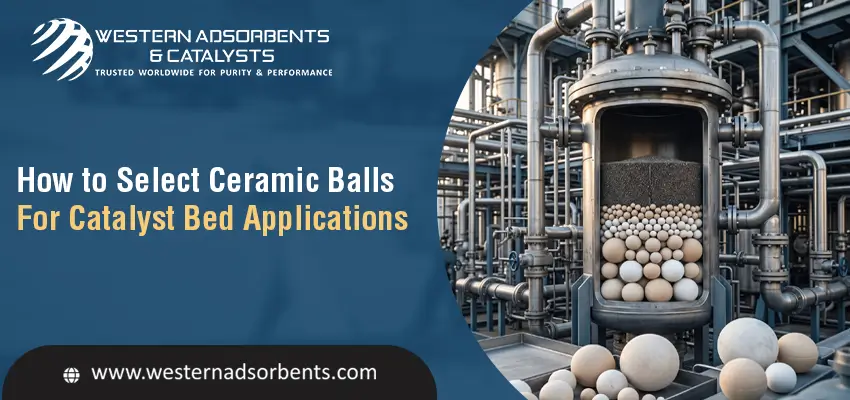
When people talk about a catalyst bed, the focus is usually on the catalyst itself - its activity, performance and service life. The ceramic balls supporting that catalyst often get much less attention.
That can be a costly mistake.
Ceramic balls support the catalyst, help distribute the process flow, keep the bed stable and can prevent dirt or loose particles from reaching the catalyst. If the balls are too weak, incorrectly sized or unsuitable for the operating conditions, they can cause problems such as higher pressure drop, channelling, catalyst movement and even unplanned shutdowns.
In this guide, Western Adsorbents & Catalysts explain what ceramic balls do inside a catalyst bed and the main things to consider when selecting them.
In Short: Choose ceramic balls based on four main factors: chemical composition, size and grading, mechanical strength, and porosity. The alumina and silica content should suit the operating temperature and steam conditions. The ball sizes should be properly graded so the catalyst stays in place. Crush strength and thermal shock resistance are important for long-term reliability, while porosity depends on whether the balls are being used mainly for support or for trapping contaminants.
What Do Ceramic Balls Do in a Catalyst Bed?
Inert ceramic balls are used in many industrial vessels, including hydrotreaters, reformers, sulphur recovery units, ammonia and hydrogen plants. Similar support layers are also found in dryers and adsorber vessels.
Their main jobs are:
➤ Support: Ceramic balls at the bottom of the vessel support the weight of the catalyst bed and help prevent catalyst particles from reaching the outlet system.
➤ Hold-down: A layer above the catalyst can help keep the bed in place during pressure changes, regeneration and changes in gas flow.
➤ Flow distribution: Properly arranged support layers help maintain more even flow through the vessel and reduce the risk of channelling.
➤ Protection: Certain porous or graded layers can catch rust, scale, dust and other particles before they reach the catalyst.
The same basic principle is used in vessels containing activated alumina and molecular sieves. These adsorbents are often supported on ceramic balls to protect the vessel internals and maintain proper gas flow.
Step 1: Match the Ceramic Composition to the Operating Conditions
The first thing to check is the chemical composition of the ceramic balls. This is especially important when the vessel operates at high temperature or in the presence of steam.
Ceramic balls are available with different alumina and silica levels. In simple terms, they can be divided into three common groups:
| Type | Typical Composition | Common Application |
| Standard inert balls | Lower alumina, higher silica | General support applications at moderate temperatures |
| Medium alumina balls | Intermediate alumina content | Higher-temperature and more demanding service |
| High alumina balls | Very high alumina with low silica | High-temperature and steam-rich applications |
Why Does Silica Content Matter?
At high temperatures, particularly when steam is present, silica can gradually migrate from the ceramic material. This can potentially travel downstream and deposit on catalysts or other equipment.
This is a particular concern in steam reformers, secondary reformers and similar high-temperature applications. Where the catalyst is sensitive to silica, a low-silica, high-alumina grade is generally a safer choice.
High alumina balls can cost more, but the additional cost may be justified when the process conditions require them.
Don't Ignore Impurities
Alkalis, iron and other impurities can also matter. Some catalysts are sensitive to these elements, so it is worth asking for information about leachable impurities rather than looking only at the total chemical composition.
The balls should also have sufficient resistance to any acidic condensate or chemical compounds present in the process.
Step 2: Choose the Right Size and Grading
Ceramic balls are available in different sizes, from small balls of a few millimetres to much larger balls around 50 mm or more.
In most catalyst beds, using only one size is not the best approach. Instead, the support is normally arranged in several graded layers.
The layer closest to the catalyst uses smaller balls, while the layers below gradually increase in size toward the vessel outlet.
The purpose is straightforward: the catalyst should not be able to work its way down between the support balls.
A few points are particularly important:
➤ Layer depth: Each layer needs enough depth to remain continuous across the vessel. The exact depth should follow the reactor or vessel designer's loading instructions.
➤ Hold-down layer: The balls directly above the catalyst need to be large enough to remain on top of the catalyst while still providing effective hold-down.
➤ Gradual size changes: Avoid making large jumps between ball sizes. A properly graded arrangement helps prevent smaller balls and catalyst particles from moving into the lower layers.
➤ Pressure drop: Smaller balls generally create more resistance to flow. The grading therefore needs to provide good support without unnecessarily increasing pressure drop.
The exact size combination should always be based on the catalyst particle size, vessel design and process conditions rather than a general size chart.
Step 3: Check Mechanical and Thermal Strength
Ceramic balls at the bottom of a catalyst bed may carry the weight of several tonnes of catalyst. They also have to withstand pressure changes and temperature cycling.
Weak balls can crack or break during service. Once that happens, the resulting fines can collect around screens and outlets, increase pressure drop and affect the stability of the bed.
When comparing ceramic balls suppliers, ask about:
➤ Crush strength: This indicates how much load the balls can withstand before breaking.
➤ Thermal shock resistance: Important where the vessel experiences rapid heating and cooling.
➤ Maximum operating temperature: The selected grade should have an appropriate margin above the actual operating temperature.
➤ Water absorption and porosity: These provide useful information about the structure and density of the ceramic.
➤ Bulk density: This is needed when calculating how much material is required for each layer and the load placed on vessel internals.
Step 4: Decide Whether You Need Porous Ceramic Balls
Not all ceramic balls are designed to perform exactly the same job. Dense ceramic balls are mainly used for mechanical support. Porous ceramic balls, on the other hand, can be useful where the upper part of the bed needs to catch dust, scale, iron particles, coke fines or other contaminants.
For example, in some hydroprocessing applications, a porous layer above the catalyst can act as a fouling trap. It captures unwanted material before it reaches and blocks the catalyst bed.
Porous balls should not simply replace dense support balls. Their strength and purpose are different, so they should be used in the part of the bed where their filtration or fouling-trap function is actually required.
Step 5: Load the Balls Carefully
Even good-quality ceramic balls can be damaged during installation if they are handled roughly.
Keep these points in mind during loading:
➤ Avoid excessive drop height: Do not allow the balls to fall from a great height onto a hard surface. Use suitable loading equipment and keep the drop as low as practical.
➤ Level each layer: Make sure every layer is evenly distributed before adding the next one.
➤ Keep different sizes separated: Where necessary, use suitable screens or other arrangements to prevent different grades from mixing.
➤ Inspect the material: Check bags, drums or containers for broken, chipped or incorrectly sized balls before loading.
➤ Keep the material protected: Store the balls properly before installation, particularly when the material will be used with moisture-sensitive catalyst or adsorbent.
Ceramic balls do not necessarily need to be replaced every time the catalyst is changed. If the existing balls are still clean, strong and within the required size range, they may be suitable for reuse after proper inspection.
Common Mistakes When Buying Ceramic Balls
Several problems can be avoided by checking the specifications before placing an order.
➤ Choosing only by price: A low-cost product may not be suitable for your temperature, steam conditions or catalyst chemistry.
➤ Using a standard grade in high-temperature steam service: This can increase the risk of silica-related problems.
➤ Ignoring size grading: Poor grading can allow catalyst migration and affect the stability of the bed.
➤ Mixing different grades: Differences in size, density and strength can create uneven loading.
➤ Not checking impurities: This can be a problem when the catalyst is sensitive to iron, sodium or other contaminants.
➤ Ignoring loading practices: Excessive impact during installation can damage the balls before they even enter service.
Choosing a Ceramic Balls Manufacturer in India
Selecting ceramic balls should start with the application, not just the required size and quantity. The operating temperature, catalyst size, steam conditions, vessel arrangement and required mechanical strength all influence the right grade.
Western Adsorbents & Catalysts supplies ceramic balls for catalyst support, hold-down and distribution applications in industries such as refining, petrochemicals, fertilisers and gas processing. The available grades can be selected according to factors such as alumina content, size, strength and operating conditions.
For buyers comparing ceramic balls manufacturers in India, it is useful to provide the vessel loading diagram or existing specification. This makes it easier to select the correct sizes and calculate the quantity required for each layer.
Western Adsorbents & Catalysts also supplies related adsorbent products, including activated alumina balls and molecular sieves, for applications such as gas drying and purification.
Need Ceramic Balls for a Catalyst Bed?
Share the vessel drawing or loading diagram along with the catalyst or adsorbent size, operating temperature, pressure and steam conditions. These details can be used to determine the appropriate ceramic ball grade, size combination and quantity for each layer.
Frequently Asked Questions
1. What Is the Difference Between Inert and High Alumina Ceramic Balls?
➤ The main difference is their alumina and silica content. Standard inert ceramic balls generally contain more silica and are suitable for many general support applications. High alumina balls contain much more alumina and less silica, making them better suited to high-temperature or steam-rich services where silica carryover is a concern.
2. What Size Ceramic Balls Should I Use Under My Catalyst?
➤ The correct size depends on the catalyst particle size and the design of the vessel. The balls directly below the catalyst should be large enough to prevent catalyst particles from passing through the gaps. The layers below are then normally increased in size gradually toward the outlet.
3. Can Ceramic Balls Be Reused After a Catalyst Change?
➤ Yes, they can sometimes be reused. The balls should first be inspected for cracks, excessive wear, chemical attack, fouling and size loss. Any damaged or unsuitable material should be removed and replaced with the correct grade.
4. Why Do Ceramic Balls Crack During Service?
➤ Cracking can result from thermal shock, excessive mechanical loading, unsuitable material strength or rough handling during installation. Rapid heating and cooling can be particularly hard on ceramic materials. Selecting a grade with suitable crush strength and thermal resistance can help reduce these problems.