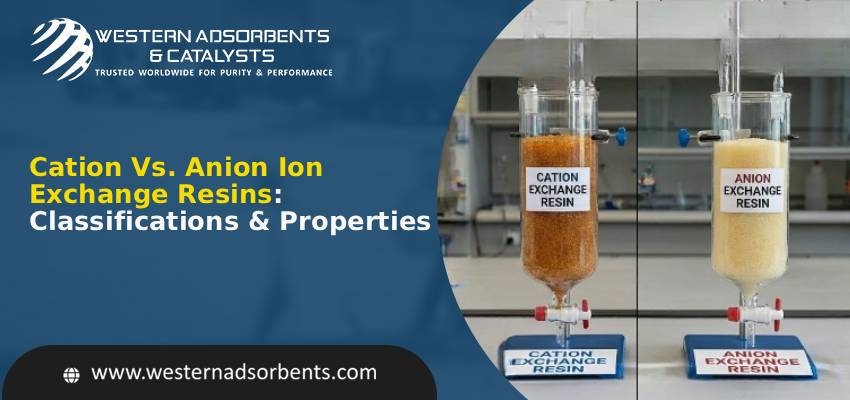
Ion exchange resins play an important role in water treatment applications. These resins are widely used in water softening, purification and demineralization uses. Anion and cation resins are two of the main types of ion exchange resins. When working with these technologies, it is important to understand the difference between cation and anion ion exchange resins and their similarities. In this blog, we explore anion Vs. cation ion exchange resins to help industries find the right solution for their applications.
Anion Vs. Cation Ion Exchange Resins: Understanding Ion Exchange Resins
What Is An Anion Exchange Resin?
Anion exchange resins consists positively charged functional groups like quaternary ammonium. These resins exchange negatively charged ions from water, including sulfate, chloride, silica, nitrate, and bicarbonate.
What Is A Cation Exchange Resin?
Cation exchange resins are composed of cross-linked polystyrene matrices charged with negative functional groups like sulfonic groups. These resins attract and exchange positively charged ions in water, including calcium, magnesium, sodium and iron.
How Are Cation and Anion Exchange Resins Similar?
Cation and anion exchange resins are highly porous synthetic resins with a fixed specific charge. The fixed charge is a part of the resin's crosslinked structure. Every resin bead has a neutralizing counterion that moves in and out of the bead, which is replaced with ions of similar charge during the ion exchange process. The water treatment industry relies on ion exchange resin manufacturers India for applications like water softening, demineralization and other applications.
What is the Difference Between Cation and Anion Exchange Resins?
These are two of the most commonly used resins used in ion exchange processes in various applications. The main difference between cation and anion exchange resins is that the cation is positively charged, while the anion is negatively charged. These resins can either be used together (supercharged resins) or in separate vessels as per your requirements. When choosing between anion vs. cation resins, there are some physical and chemical properties to be taken into consideration. Some of the properties to consider are:
Also Read: Types of Ion Exchange Resin
➤ The size of the ion exchange resin beads
➤ The amount of water the resins can hold
➤ The number of ions the resins can remove before replacement
➤ The required water quality
➤ The type of contaminants in the water source quality
| Anion Vs. Cation Exchange Resins Comparison |
| Parameter | Cation Exchange Resins | Anion Exchange Resins |
| Target Ions | Positive ions | Negative ions |
| Fixed Charge on Resin | Negative | Positive |
| Functional Group | Sulfonic acid groups | Quaternary ammonium groups |
| Common Ions Removed | Calcium (Ca²⁺), Magnesium (Mg²⁺), Sodium (Na⁺), Iron (Fe²⁺/Fe³⁺) | Chloride (Cl⁻), Sulfate (SO₄²⁻), Nitrate (NO₃⁻), Silica (SiO₂), Bicarbonate (HCO₃⁻) |
| Common Applications | Water softening, hardness removal, pre-treatment | Demineralization, desalination, silica & nitrate removal |
How To Choose the Right Resin?
When selecting between cation and anion resins, consider the following points:
➤ What type of contaminants do you want to remove?
➤ Demineralization or softening, which is the target?
➤ What is the system design or water quality?
Understanding the main difference between cation and anion exchange resins is crucial for specific water treatment applications. At Western Adsorbents & Catalysts, as a top ion exchange resin supplier in India, we offer long-lasting and the highest quality resins. Whether you need resins for wastewater treatment plants or RO systems, call us.
Check: What is Ion Exchange Resin?