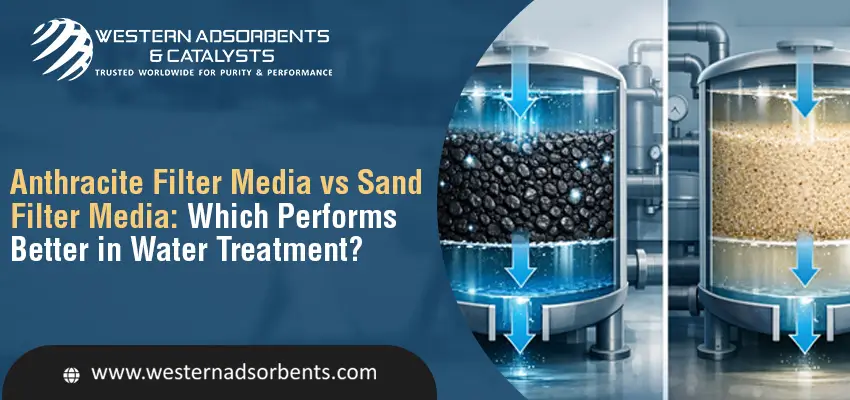
Filter media is the foundation of any water treatment system. Whether you are running a municipal drinking water plant, an industrial effluent treatment unit, or a high-flow process water system, the filtration media you select determines your throughput, effluent quality, backwash frequency, and operating costs for years to come. Sand has been used as a filter medium for over a century. It is affordable, widely available, and well understood. But over the past few decades, anthracite coal has steadily displaced sand as the preferred filtration material in high-performance water treatment systems worldwide and for good, technically sound reasons.
So, which is actually better for your application? In this blog, we discuss anthracite filter media Vs sand filter media to select the right filter medium for your specific treatment objectives.
Anthracite Filter Media Vs Sand Filter Media: Understanding Filter Media
What Is Anthracite Filter Media?
Anthracite is the highest grade of coal, containing 80–95% carbon, with very low volatile matter and ash content. For filtration use, it is crushed and graded into specific particle sizes, typically 0.8 mm to 2.0 mm, to ensure effective water treatment performance. One of anthracite’s key advantages is its lower bulk density compared to sand, about 0.75–0.9 g/cm³ versus 1.55–1.75 g/cm³ for sand. This lighter density creates a more open filter bed, allowing water to flow at higher rates while still effectively trapping suspended solids.
High-quality anthracite coal India used in water filtration is valued for its hardness, angular particle shape, chemical stability, and resistance to wear during backwashing. These properties ensure long service life and consistent filtration performance in water treatment systems.
Read: What Is Anthracite Coal?
What is Sand Filter Media?
Silica sand has been the popular filter medium in water treatment applications for generations. It is produced from natural quartz deposits, graded by particle size (typically 0.4 mm to 1.0 mm for filtration), and used in both single-media and multi-media filter beds. Sand's high bulk density and fine particle size give it a strong fine-particle retention capability but limit its flow rate potential. Sand beds compact under hydraulic load, which increases pressure drop and necessitates more frequent backwashing to restore permeability.
Anthracite Filter Media Vs Sand Filter Media: Physical and Chemical Properties

Performance Comparison: 8 Key Criteria
#1 Filtration Rate (Flow Rate Capacity)
➤ Anthracite: Higher Flow Performance
Its lower density and coarser particles create a more open filter bed, allowing higher filtration rates, typically 10–20 m³/m²/h, compared to sand’s 5–10 m³/m²/h. This enables greater output from the same filter vessel or allows the use of smaller, more cost-efficient systems.
➤ Sand: Limited at Higher Flow
Fine sand beds develop greater hydraulic resistance. At higher flow rates, particles can compact and clog pores, increasing pressure drop and requiring more frequent backwashing.
#2 Turbidity and Suspended Solids Removal
➤ Anthracite: Excellent When Properly Designed
Its angular particles create a more complex flow path, improving contact between water and filter media. Although the grains are coarser, well-graded anthracite can achieve turbidity removal comparable to sand when bed depth and loading rates are properly designed. In dual-media filters, anthracite captures most suspended solids while the sand layer provides final polishing.
➤ Sand: Effective for Fine Particles
Sand’s smaller, rounded grains are efficient at capturing suspended particles, especially in the 1–10 micron range. With proper upstream coagulation, single-media sand filters can achieve effluent turbidity below 0.5 NTU.
#3 Bed Depth and Vessel Sizing
➤ Anthracite: Shallower Beds Possible
Its larger particle size allows effective solids removal with a shallower filter bed, reducing vessel height, capital costs, and enabling easier retrofits in existing systems.
➤ Sand: Deeper Beds Needed
To achieve similar filtration performance, especially in high-turbidity water, sand typically requires greater bed depth, increasing vessel size, construction costs, and pressure loss.
#4 Pressure Drop Across the Bed
➤ Anthracite: Lower Pressure Drop
Its coarser, less compact bed allows smoother water flow, resulting in lower pressure loss and reduced pumping energy, which lowers operating costs in continuous systems.
➤ Sand: Higher Head Loss
Fine sand creates greater flow resistance, requiring more pumping energy. As solids accumulate, the pressure drop rises faster than in anthracite beds.
#5 Backwash Efficiency and Water Consumption
➤ Anthracite: More Efficient Backwashing
Its lower density allows the bed to expand easily at lower backwash rates (15–25 m³/m²/h), releasing trapped solids effectively while using less backwash water.
➤ Sand: Higher Backwash Demand
Sand requires higher backwash velocities to expand the bed and remove solids, leading to greater water usage and higher operational costs.
#6 Attrition Resistance and Service Life
➤ Anthracite: Longer Service Life
High-quality anthracite coal manufacturer in India product is used in filtration for its hardness and resistance to wear. It maintains its particle size over many backwash cycles, with minimal breakdown, and typically lasts 7–10 years or more in well-operated systems.
➤ Sand: Also Durable
Sand is naturally hard and chemically stable, offering long service life in standard filtration. However, under highly acidic or alkaline cleaning conditions, sand may slowly dissolve, while anthracite remains stable across a wider pH range.
Summary Verdict: Anthracite Coal Vs. Sand

Conclusion
The comparison is clear: anthracite filter media outperforms sand across most of the criteria that matter most in modern water treatment, including filtration rate, pressure drop, backwash efficiency, filter run length, and total lifecycle cost. For high-flow municipal plants, industrial process water systems, and any application where operational efficiency and effluent consistency are priorities, anthracite is the superior single-medium choice.
Sand remains a cost-effective option for low-demand applications where initial media cost is the dominant selection criterion.
Anthracite Filter Media from Western Adsorbents & Catalysts
Western Adsorbents & Catalysts is one of the leading anthracite coal suppliers in India, supplying graded anthracite filter media to municipal water treatment plants, industrial process water systems, and export markets across the Middle East, Southeast Asia, and Africa.
W.A.C.'s anthracite filter media is available in semi-standard (70–80% carbon), high-grade (80–90% carbon), and ultra-grade (90–95% carbon) specifications, graded to precise effective sizes for single-media and dual-media filtration applications. All products are supplied with full Certificate of Analysis documentation covering particle size distribution, bulk density, specific gravity, acid solubility, and attrition resistance.
In addition to anthracite, W.A.C. supplies the complete range of water treatment media — including NSF-grade granular and powdered activated carbon for organic removal and taste-and-odour control. As one of the most established coconut shell activated carbon manufacturers in India, W.A.C. regularly supplies both anthracite and activated carbon together for multi-media and layered filtration systems that combine physical filtration with adsorptive polishing in a single vessel configuration. Reach us at +91 81406 80001 | mail@westernadsorbents.com to know more.