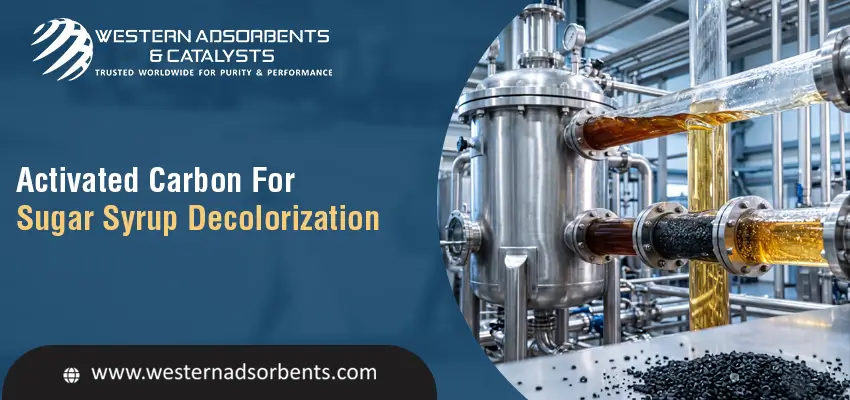
Raw sugar is not white, and it never was. Straight from the mill, the crystals carry a brown film of colour. Even after washing and clarification, the melted syrup still looks more like weak tea than the water-clear liquor a refinery wants before crystallisation. Getting from one to the other is the job of decolorization, and activated carbon has been doing it in sugar refineries for well over a century.
It is still one of the most flexible tools available. The same basic material serves a small liquid sugar plant, a large cane refinery and a glucose syrup unit, as long as the grade and the process conditions are right. In this guide, Western Adsorbents & Catalysts explains where sugar colour comes from, how carbon removes it, and what to look for when you choose a grade.
In Short: Clarified sugar syrup is treated with powdered activated carbon (PAC) in a stirred tank, or passed through columns of granular activated carbon (GAC). The carbon adsorbs large colour-forming molecules into its pores. The syrup is then filtered and sent on to ion exchange, evaporation or crystallisation. Sugar colourants are big molecules, so they need wider pores than most gas or water applications, which makes carbon choice critical.
Where Does the Colour in Sugar Syrup Come From?
➤ Sugar colour is not one compound: It is a mixture, and each part behaves a little differently.
➤ Plant pigments: Polyphenols and flavonoids carried over from the cane or beet.
➤ Melanoidins: Brown polymers formed when sugars react with amino acids during heating. This is the same Maillard chemistry that browns bread crust.
➤ Caramels: Formed when sugar itself is overheated during evaporation and boiling.
➤ Alkaline degradation products: Formed when invert sugars break down at high pH and temperature.
Most of these are large molecules, and some are very large. That single fact drives almost every decision about which carbon to use.
Refiners measure colour in ICUMSA units, read as light absorbance at 420 nm on a filtered, pH-adjusted solution. The lower the number, the whiter the sugar. Refined white sugar sits far below plantation white, and every stage of the refinery is expected to take out its share of colour.
Where Carbon Fits in the Refining Process
A typical cane refinery works in stages:
➤ Raw sugar is washed (affination).
➤ It is melted into syrup.
➤ The syrup is clarified by phosphatation or carbonatation, which removes suspended matter and part of the colour.
➤ Decolorization comes next. This is where carbon, ion exchange resin, or both, do the heavy lifting.
Many refineries put carbon ahead of the resin. The carbon removes most of the high-molecular-weight colour, and the resin polishes what remains. That order also protects the resin from large organic molecules that foul it. Western Adsorbents & Catalysts is also one of the established ion exchange resin suppliers, so refineries can source both stages of decolorization from a single supplier and match them to each other.
Carbon is used the same way in glucose syrup, dextrose, high-fructose syrup and liquid sugar production. There it also removes odour, off-flavours and traces of HMF (hydroxymethylfurfural), which affect taste and shelf life.
Powdered or Granular: Which Suits Your Plant?
Both work. The choice usually comes down to plant size, how much colour you need to remove, and whether you can regenerate carbon on site.
| Powdered Activated Carbon (PAC) | Granular Activated Carbon (GAC) | |
| How It Is Used | Dosed into a stirred tank, then filtered out | Syrup flows through packed columns |
| Flexibility | Dose can change batch by batch | Steady, continuous operation |
| Capital Cost | Low: tank, dosing, filter | Higher: columns, often a regeneration kiln |
| Carbon Use | Single use, then disposed | Thermally regenerated and reused |
| Typical Fit | Smaller refineries, liquid sugar, glucose syrup | Large refineries with steady throughput |
PAC is forgiving. If a batch of raw sugar comes in darker than usual, the operator raises the dose and carries on. GAC takes more investment. In a large refinery, though, regeneration in a multiple-hearth furnace or rotary kiln usually pays that back through lower carbon cost per tonne. Plants running columns should work with granular activated carbon suppliers who can guarantee consistent make-up carbon batch after batch, because mixing mismatched grades in a column upsets its performance.
Process Conditions That Make or Break Decolorization
Carbon performance depends heavily on how the syrup is presented to it.
➤ Temperature: Syrup is usually treated hot, commonly around 75 to 80 °C. Heat lowers viscosity, so colour molecules reach the carbon's pores faster. Go much hotter than that and you start creating new colour through caramelisation and invert breakdown.
➤ pH: Carbon generally removes colour better at slightly lower pH, but sugar syrup punishes you for going too far. Acidic conditions invert sucrose into glucose and fructose, which lowers yield and forms new colour later in the process. Most plants hold the syrup close to neutral.
➤ Brix: Refinery liquor is typically treated at around 60 to 65 Brix. Thinner syrup filters more easily, but it costs more steam to evaporate afterwards.
➤ Contact Time: PAC needs enough stirring time for adsorption to approach equilibrium. Depending on the carbon and the colour load, that is anywhere from a matter of minutes to an hour. With GAC, the flow rate through the column sets the contact time.
➤ Filtration: With PAC, poor filtration undoes good decolorization. Fine carbon slipping into the syrup shows up as grey sugar or a hazy product. The usual answer is pressure leaf filters or filter presses with a precoat of filter aid, and the carbon's particle size should suit the filter you have.
➤ Water Quality: Refineries use large volumes of process and boiler water, and poor water quality feeds problems back into the syrup circuit. Multimedia filters with graded media are common in refinery water treatment. Western Adsorbents & Catalysts also works as one of the anthracite coal suppliers in India and a garnet supplier for exactly these filter beds.
What to Look for in Activated Carbon for Sugar Decolorization
➤ Mesopores Surface Area: This is where many buyers go wrong. A carbon with a high iodine number looks strong on paper, but iodine number mostly reflects small micropores, and sugar colourants are far too large to use them. What you need is a well-developed mesopore structure. For this duty, molasses number, or a decolourisation test on your own syrup, tells you much more than iodine number.
➤ Low ash and Low Iron: Ash from the carbon can leach into the syrup and raise the sugar's ash content. Iron is worse, because it can form coloured complexes with polyphenols and undo part of the work the carbon just did. Acid-washed grades are usually preferred for food-grade sugar.
➤ Controlled pH of the Carbon: A carbon with a strongly alkaline or acidic surface will shift the syrup's pH during treatment. That can encourage inversion or colour formation.
➤ Food-grade Compliance: Carbon in contact with sugar must meet the relevant food safety requirements, such as FSSAI in India and the Food Chemicals Codex for export-oriented products. Ask for documentation, not just a data sheet. Any reputable manufacturer of activated charcoal for food use should provide it without hesitation.
➤ Filterability (PAC): Two powdered carbons with similar decolorizing power can behave very differently on the filter. Very fine carbon adsorbs faster, but it slows filtration and raises the risk of carbon breakthrough.
➤ Hardness (GAC): Granular carbon in columns goes through repeated thermal regeneration. Soft carbon breaks down and loses mass in the kiln, which raises your make-up carbon cost.
Is Coconut Shell Carbon Right for Sugar Syrup?
Usually not as the main decolorizing carbon, and it is worth being clear about why. Coconut shell carbon is highly microporous. That makes it excellent for gases, small organic molecules and gold recovery, but it leaves relatively little room for the large colour bodies in sugar liquor. Wood-based and suitably activated coal-based grades, with more mesopores, generally decolorize sugar syrup more efficiently.
Coconut shell grades can still play a role, for example in polishing, odour removal, or treating the water used around the refinery. Western Adsorbents & Catalysts is among the coconut shell activated carbon manufacturers in India that will tell you plainly which grade suits which step, rather than pushing one carbon for everything.
Common Reasons Decolorization Falls Short
➤ Poor Clarification Upstream: Suspended solids and gums coat the carbon and block its pores before it has done its work.
➤ The Wrong Pore Structure: A carbon chosen on iodine number alone often disappoints on real syrup.
➤ Syrup Too Hot or Too Alkaline: New colour forms during treatment, and the carbon ends up chasing a moving target.
➤ Carbon Fines in the Product: Usually a filter or precoat problem. Sometimes the carbon is simply too fine for the equipment.
➤ Stale GAC: Regeneration that is too light, or a column left on line too long, lets colour through.
➤ Exhausted Ion Exchange Resin Downstream: Colour that the resin should catch slips through and gets blamed on the carbon. Check both stages before changing your carbon grade.
Choosing an Activated Carbon Manufacturer in India
For sugar and syrup decolorization, the best carbon is the one tested on your syrup under your conditions. Data sheet numbers are only a starting point.
Western Adsorbents & Catalysts is an activated carbon manufacturer in India supplying powdered and granular grades for food processing, including sugar and syrup decolorization. As one of the experienced bulk activated carbon suppliers to refineries and syrup plants, we supply in the volumes a continuous operation needs, with consistent quality from lot to lot.
When you compare activated carbon suppliers in India, share these details so the supplier can match pore structure, ash and particle size to your process:
➤ Syrup type and Brix
➤ Inlet and target colour
➤ Treatment temperature
➤ Filtration setup
If you are speaking with coconut shell carbon suppliers for a sugar application, ask directly whether their grade has enough mesoporosity for sugar colourants. A straight answer to that question tells you a lot about the supplier.
Need Carbon for Sugar or Syrup Decolorization?
Send Western Adsorbents & Catalysts your syrup details and current colour readings. We will suggest a grade and a starting dose, and we can run a decolorization comparison on a sample of your syrup. If your refinery also uses resin polishing, we can review both stages together.
Frequently Asked Questions
1. How much powdered activated carbon is needed to decolorize sugar syrup?
➤ There is no universal dose. It depends on the incoming colour, the target colour, the carbon grade and the process conditions. The reliable way to set it is a jar test on your own syrup, followed by fine-tuning on the plant.
2. Can activated carbon replace ion exchange resin in a sugar refinery?
➤ In some plants, yes, particularly smaller refineries and liquid sugar units. Many larger refineries use both: carbon for most of the colour, and resin to polish. Western Adsorbents & Catalysts supplies activated carbon and ion exchange resin for both setups.
3. Can granular activated carbon used for sugar be regenerated?
➤ Yes. Spent GAC from sugar refining is commonly regenerated thermally in a furnace or kiln and returned to the columns. A small amount of make-up carbon replaces what is lost in each regeneration cycle.
4. Why is iron content important in carbon for sugar?
➤ Iron leached from the carbon can react with natural polyphenols in the syrup to form coloured compounds. That puts colour back into a product you were trying to whiten. Acid-washed, low-iron grades avoid the problem.