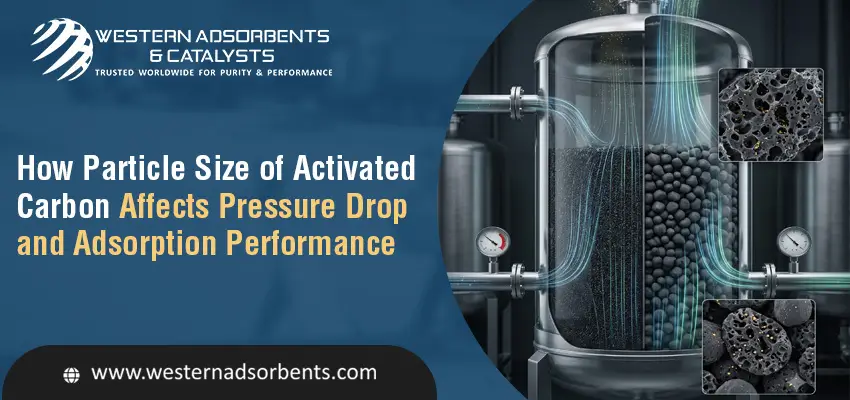
In an activated carbon filtration system, particle size is not simply a specification listed on a product datasheet. It directly influences how quickly contaminants reach the carbon surface, how much resistance the filter creates, and how efficiently the treatment bed operates.
Western Adsorbents & Catalysts offers activated carbon solutions for industrial adsorption and filtration applications, with product selection based on factors such as particle size, pore structure, and application requirements. Understanding these characteristics helps industries select carbon that provides an appropriate balance between adsorption performance and hydraulic efficiency.
Particle Size Is a Performance Variable
Activated carbon contains an extensive network of pores where adsorption takes place. However, contaminants must first move from the bulk fluid to the external surface and then into the internal pore structure.
Particle size affects this movement.
When the carbon particle is smaller, the distance that adsorbate molecules need to travel inside the particle is generally reduced. This can improve mass transfer and allow adsorption to occur more quickly.
With larger particles, the fluid can move through the bed more easily, but the internal diffusion path can be longer.
This creates an important engineering trade-off:
Smaller particles → faster adsorption kinetics but potentially higher pressure drop
Larger particles → lower pressure drop but potentially slower mass transfer
The optimum size depends on the application rather than simply choosing the smallest or largest available particle.
What Happens to Pressure Drop?
Pressure drop is the difference in pressure between the inlet and outlet of a carbon bed. It represents the resistance that the packed material creates against fluid flow.
Particle size has a significant influence on this resistance.
A bed containing smaller particles generally has smaller flow channels between particles. As a result, the fluid experiences greater resistance while passing through the bed, which can increase the pressure required to maintain the desired flow rate.
Larger particles create comparatively larger void spaces and can reduce hydraulic resistance.
For continuous systems, this becomes an important design consideration because excessive pressure drop can increase pumping or compression requirements and affect overall operating efficiency.
Does Smaller Carbon Always Adsorb Better?
Not necessarily.
Smaller particles can improve adsorption kinetics, but particle size is only one part of activated carbon performance.
Overall adsorption depends on several factors, including:
➤ Pore-size distribution
➤ Surface area
➤ Adsorbate concentration
➤ Contact time
➤ Temperature
➤ Fluid composition
➤ Carbon type and activation method
➤ Bed depth and operating conditions
Reducing particle size cannot compensate for an activated carbon whose pore structure is unsuitable for the contaminant being removed.
This is why an experienced activated carbon manufacturer should consider both the carbon's physical characteristics and the intended operating conditions when recommending a grade.
Particle Size and Adsorption Kinetics
Adsorption kinetics describe how quickly contaminants transfer from the fluid phase onto and into activated carbon.
Smaller particles generally provide shorter intraparticle diffusion distances. This can allow contaminants to reach internal adsorption sites more rapidly, which is particularly useful when contact time is limited.
However, this does not automatically mean that smaller particles have greater total adsorption capacity. Their primary advantage may be faster utilization of the available adsorption capacity.
In fixed-bed systems, this distinction is important. If adsorption occurs too slowly, contaminants may pass through the bed before the available carbon capacity is effectively utilized.
Particle size should therefore be considered alongside empty bed contact time (EBCT), flow rate, contaminant concentration, and the required removal level.
The Pressure Drop–Adsorption Trade-Off
Consider two simplified filtration systems.
A system using very fine carbon may provide rapid mass transfer, but the resulting pressure drop could make continuous operation inefficient.
A system using very coarse carbon may have lower hydraulic resistance, but slower adsorption kinetics could reduce contaminant removal when contact time is limited.
The practical objective is therefore not to maximize adsorption speed or minimize pressure drop independently.
It is to find a particle size that provides an acceptable balance between hydraulic performance and adsorption kinetics.
This balance becomes particularly important when designing large industrial adsorption beds.
Particle Size Distribution Matters Too
Average particle size does not tell the entire story.
A carbon bed contains particles within a specified size range. If the distribution contains excessive fines, smaller particles can occupy spaces between larger particles, reducing void volume and increasing resistance to flow.
Fines can also contribute to downstream carryover if the system is not properly designed.
For this reason, particle-size distribution, effective particle size, uniformity, and mechanical strength should all be considered when selecting granular activated carbon.
For this reason, particle-size distribution, effective particle size, uniformity, and mechanical strength should all be considered when evaluating granular activated carbon suppliers.
How Should Particle Size Be Selected?
A practical selection process should begin with operating conditions rather than the carbon grade alone.
Start with flow: Determine the required flow rate and acceptable pressure-drop range.
Define contact time: Establish how long the fluid will remain in contact with the carbon.
Identify the contaminant: Molecular size, polarity, concentration, and other properties influence adsorption behaviour.
Evaluate carbon characteristics: Compare pore structure, surface area, particle size, hardness, and adsorption performance.
Consider the carbon source: Coconut-shell carbon, coal-based carbon, and other activated carbons can have different pore structures and adsorption characteristics. Industries evaluating coconut shell activated carbon manufacturers in India should
therefore compare technical specifications rather than selecting solely on the basis of raw material.
Why Supplier Selection Matters
Particle size should be treated as part of the complete carbon specification. A supplier should be able to provide consistent particle-size distribution and explain how the selected grade is expected to perform under the intended operating conditions.
Western Adsorbents & Catalysts can support application-specific activated carbon selection by considering particle-size requirements alongside operating conditions, contaminant characteristics, and required adsorption performance.
For companies comparing an Activated Carbon Manufacturer in the USA, supplier location alone does not determine suitability. Technical specifications, quality consistency, testing, application requirements, and supply capability should also be evaluated.
A reliable manufacturer of activated charcoal should also be able to distinguish between particle size, pore structure, surface area, and adsorption capacity rather than treating them as interchangeable measures.
Conclusion
Particle size affects two critical aspects of activated carbon operation: adsorption kinetics and pressure drop. Smaller particles can provide faster mass transfer but may increase hydraulic resistance, while larger particles can support easier fluid flow but may require more contact time.
The right selection therefore depends on balancing adsorption requirements with hydraulic limitations. Particle-size distribution, pore structure, carbon type, flow conditions, and contaminant characteristics should all be evaluated before choosing a grade.
For industrial applications where particle size, pressure drop, and adsorption performance need to be balanced, Western Adsorbents & Catalysts provides activated carbon solutions designed around specific process requirements. Contact the team to discuss the appropriate carbon grade and particle-size specifications for your application.
FAQs
Does smaller activated carbon particle size increase pressure drop?
Generally, yes. Smaller particles create narrower flow pathways within a packed bed, increasing resistance to fluid movement and potentially increasing pressure drop.
Does larger activated carbon always have lower adsorption performance?
Not necessarily. Larger particles may have slower adsorption kinetics because of longer diffusion paths, but overall adsorption capacity depends on pore structure, surface chemistry, contaminant properties, and operating conditions.
What particle size is best for granular activated carbon?
There is no universal particle size that is best for every application. The appropriate range depends on flow rate, contact time, pressure-drop limits, contaminant characteristics, and adsorption-system design.
Is particle size the same as activated carbon pore size?
No. Particle size refers to the physical dimensions of the carbon granules, while pore size refers to the microscopic openings within the carbon structure. Both influence adsorption performance but describe different properties.