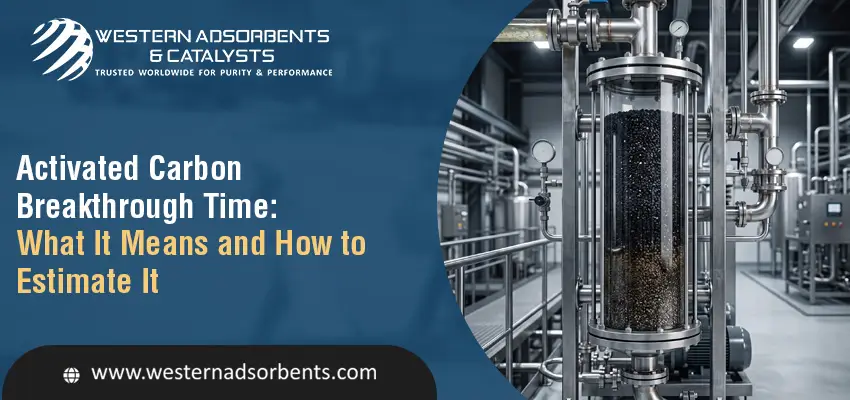
Activated carbon removes contaminants from water, gases, and industrial process streams, but its adsorption capacity is not unlimited. As a carbon bed operates, contaminants gradually occupy available adsorption sites. Eventually, contaminant concentration at the outlet begins to rise. The time taken to reach a defined outlet concentration is known as activated carbon breakthrough time.
Western Adsorbents & Catalysts supplies activated carbon and adsorption media for industrial purification applications. Understanding breakthrough time helps engineers estimate carbon-bed service life, plan replacement cycles, and maintain required outlet quality.
What Is Activated Carbon Breakthrough Time?
Activated carbon breakthrough time is the time required for the concentration of a target contaminant at the outlet of a carbon bed to reach a predefined breakthrough limit.
When a fresh carbon bed starts operating, most of the contaminant is adsorbed, keeping outlet concentration low. As the carbon becomes progressively loaded, removal efficiency decreases and outlet concentration increases.
Breakthrough does not mean the carbon is completely exhausted. It means the outlet concentration has reached the limit selected for that application.
How Does Breakthrough Occur in a Carbon Bed?
As contaminated water or gas passes through an activated carbon bed, adsorption begins near the inlet. A mass transfer zone (MTZ) develops where contaminants move from the fluid phase onto the carbon.
As operation continues, the MTZ moves through the bed. When it approaches the outlet, contaminant concentration begins to increase significantly.
The process can be simplified as:
Fresh carbon → adsorption → MTZ develops → MTZ moves through bed → breakthrough → exhaustion
The rate of this process depends on carbon properties, contaminant characteristics, flow conditions, bed design, and operating conditions.
What Is an Activated Carbon Breakthrough Curve?
A breakthrough curve shows how contaminant concentration at the outlet changes during operation. It is commonly expressed using:
C/C₀
Where:
➤ C = contaminant concentration at the outlet
➤ C₀ = contaminant concentration at the inlet
Initially, C/C₀ is close to zero because the carbon removes most of the contaminant. As the bed becomes loaded, C/C₀ increases.
A predefined C/C₀ value or outlet concentration can be selected as the breakthrough point. The exact criterion depends on the treatment requirement.
A typical curve progresses from:
Low outlet concentration → rising concentration → breakthrough → increasing toward inlet concentration
How to Estimate Activated Carbon Breakthrough Time
A simplified mass-balance calculation can provide an initial estimate.
Basic Formula
Estimated service time ≈ Effective adsorption capacity × Carbon mass ÷ Contaminant loading rate
The contaminant loading rate can be estimated as:
Contaminant loading rate = Flow rate × Contaminant concentration
Example
➤ Suppose a carbon bed contains:
➤ Carbon mass: 100 kg
➤ Effective adsorption capacity: 0.10 kg contaminant/kg carbon
➤ Contaminant loading rate: 0.5 kg/hour
Effective contaminant capacity:
100 × 0.10 = 10 kg
Estimated service time:
10 kg ÷ 0.5 kg/hour = 20 hours
The simplified theoretical service time is therefore 20 hours.
However, this is not necessarily the actual breakthrough time. Real systems are affected by mass-transfer limitations, competing contaminants, channeling, changing inlet concentrations, bed geometry, and the selected breakthrough criterion.
What Is EBCT and How Does It Affect Breakthrough?
Empty Bed Contact Time (EBCT) is an important parameter for fixed-bed activated carbon systems.
EBCT = Empty bed volume ÷ Flow rate
It represents the theoretical contact time between the process stream and the carbon bed.
A higher flow rate reduces EBCT, while a lower flow rate increases it. Changes in flow conditions can therefore influence adsorption and breakthrough behaviour.
However, EBCT alone cannot determine breakthrough time. Carbon properties, contaminant characteristics, bed depth, and mass-transfer behaviour must also be considered.
What Factors Affect Activated Carbon Breakthrough Time?
1. Activated Carbon Properties
Feedstock, pore-size distribution, particle size, surface characteristics, bulk density, and activation conditions can influence adsorption performance.
For example, coconut shell activated carbon suppliers may offer carbons with predominantly microporous structures suitable for certain smaller-molecule contaminants. However, carbon should always be selected according to the specific contaminant and process.
When evaluating the largest activated carbon manufacturers, industries should also look beyond basic specifications such as surface area. Carbon quality, consistency, application suitability, technical support, and performance under actual operating conditions can all influence the reliability of a carbon bed.
2. Contaminant Concentration
Higher inlet contaminant concentration can increase the rate at which adsorption capacity is consumed. Variable inlet concentration can also change the expected breakthrough time.
3. Flow Rate
Flow rate affects contact conditions and contaminant movement through the bed, which can alter breakthrough behaviour.
4. Bed Depth and Carbon Quantity
Increasing carbon quantity generally increases available adsorption capacity. Bed depth also affects MTZ development.
However, breakthrough time does not necessarily increase in direct proportion to carbon quantity because hydraulic and mass-transfer conditions also matter.
5. Temperature, Humidity and Competing Contaminants
Temperature can affect adsorption equilibrium and kinetics. In gas-phase systems, humidity can compete for adsorption sites. Multiple contaminants can also compete for available adsorption sites and change breakthrough behaviour.
For gas-treatment applications, carbon-based molecular sieve media may be considered where selective adsorption of specific gases is required. Buyers comparing a carbon molecular sieves exporter or carbon molecular sieves manufacturers in India should evaluate the actual gas composition and operating conditions rather than choosing media only by product category.
Liquid-Phase vs Gas-Phase Breakthrough
For liquid-phase applications, pH, dissolved organic matter, water chemistry, temperature, flow rate, and competing contaminants can affect adsorption.
For gas-phase applications, humidity, temperature, pressure, gas velocity, contaminant concentration, and vapour properties can be important.
Therefore, breakthrough estimates should reflect actual process conditions. An Activated Carbon Supplier in Albania, for example, may provide a suitable carbon grade, but the correct selection still depends on the contaminant and operating conditions rather than location alone.
Western Adsorbents & Catalysts can help industries evaluate activated carbon requirements based on the contaminant, process conditions, and desired treatment performance.
Can Breakthrough Time Be Predicted Exactly?
Not with a simple capacity calculation alone.
A realistic prediction depends on:
➤ Carbon properties
➤ Contaminant characteristics
➤ Inlet concentration
➤ Flow rate
➤ EBCT
➤ Bed depth
➤ Particle size
➤ Mass-transfer behaviour
➤ Competing contaminants
➤ Temperature and humidity
➤ Breakthrough criterion
For critical applications, laboratory column testing, pilot testing, or actual operating data can provide a more reliable estimate than theoretical calculations alone.
Breakthrough vs Exhaustion
Breakthrough occurs when outlet contaminant concentration reaches the predefined limit.
Exhaustion occurs later, when the carbon's useful adsorption capacity has been substantially depleted and outlet concentration approaches the inlet concentration.
Therefore, breakthrough time should not be treated as complete carbon exhaustion time.
Frequently Asked Questions
What is the formula for activated carbon breakthrough time?
➤ Service time ≈ Effective adsorption capacity × Carbon mass ÷ Contaminant loading rate
➤ Actual breakthrough also depends on bed design, mass transfer, operating conditions, and the selected breakthrough criterion.
What is C/C₀ in a breakthrough curve?
➤ C/C₀ is the ratio of contaminant concentration at the carbon-bed outlet to its concentration at the inlet. It is commonly used to describe fixed-bed adsorption performance.
Does more activated carbon increase breakthrough time?
➤ Increasing carbon quantity can provide greater adsorption capacity and may extend service time under comparable conditions. However, flow, bed depth, mass transfer, and contaminant properties also affect breakthroughs.
Is EBCT the same as breakthrough time?
➤ No. EBCT describes theoretical contact time based on bed volume and flow rate. Breakthrough time is the time required for outlet concentration to reach the selected breakthrough limit.
➤ Western Adsorbents & Catalysts focuses on application-specific adsorption solutions rather than relying only on generic capacity values. This approach helps industries evaluate carbon selection and expected service performance.
Need Help Estimating Activated Carbon Breakthrough Time?
➤ Western Adsorbents & Catalysts provides activated carbon and adsorption media for industrial purification applications. If you need to evaluate carbon grade, adsorption capacity, EBCT, bed requirements, or expected breakthrough behaviour, contact Western Adsorbents & Catalysts with your contaminant and process conditions for an application-specific solution.