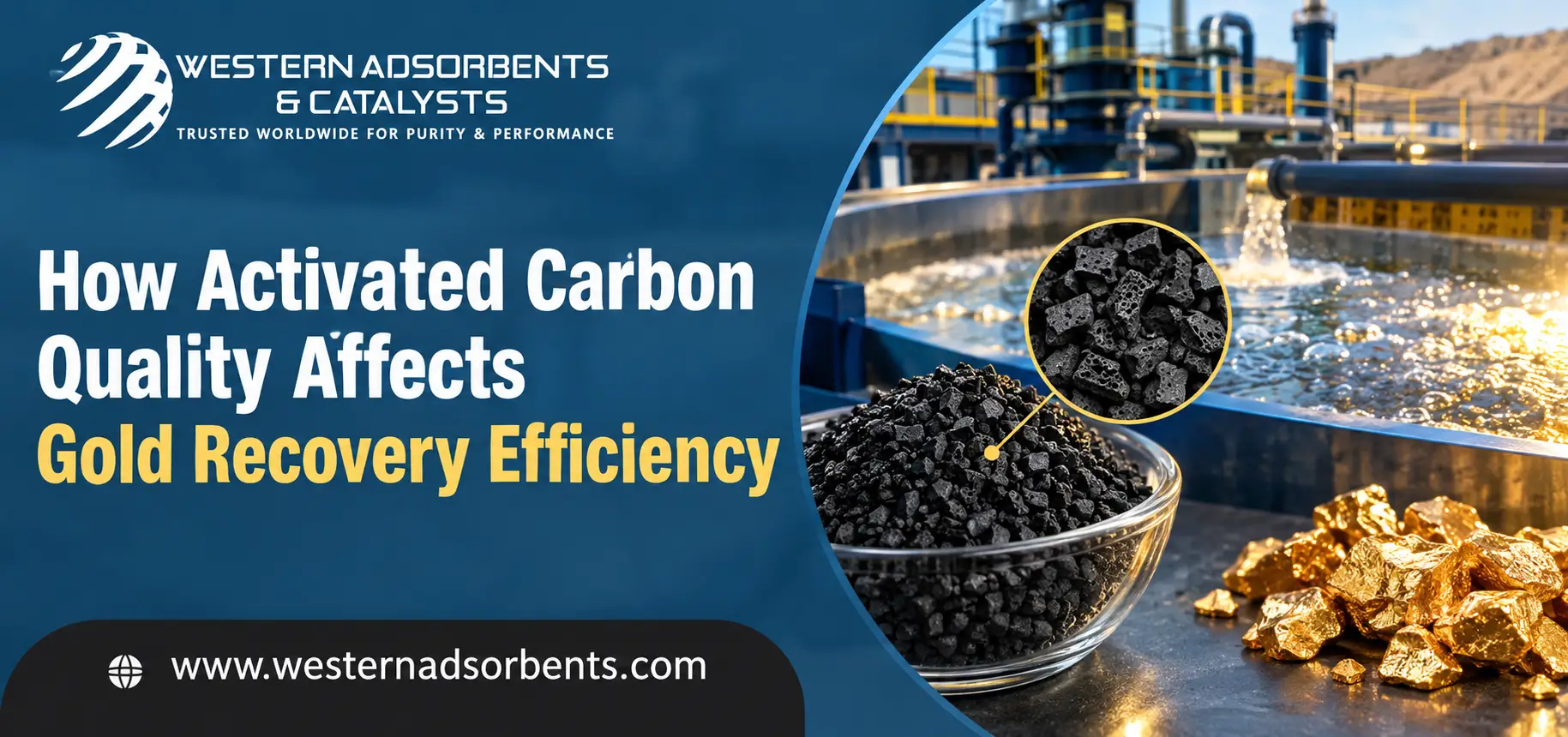
Most talk about gold recovery focuses on leaching. Fair enough, that’s where the gold goes into solution. But dissolving it is only half the job. Something has to catch the gold and hold on to it until it’s ready for elution, and in CIP and CIL plants that something is activated carbon.
So carbon quality isn’t a side issue. It decides how much of the dissolved gold you actually get to keep.
At Western Adsorbents & Catalysts, we supply activated carbon for demanding adsorption work, mining included. And when we talk to plants about gold recovery, the same point comes up again and again: hardness, attrition resistance, pore structure and adsorption performance have to be judged together. Looking at just one of them is how people end up with the wrong carbon.
Why Carbon Is Used for Gold Recovery
Cyanide leaching turns gold into a soluble gold-cyanide complex. Granular activated carbon then meets the solution or slurry, and the dissolved gold sticks to the carbon’s surface and inside its pores. Later, the loaded carbon is separated out and sent to elution, where the gold is recovered.
Here’s the catch. All of this happens in a plant that never sits still. The carbon gets stirred, pumped, screened and reused over and over. A carbon that adsorbs gold beautifully in a lab beaker can still do badly in a real circuit if it breaks apart after a few weeks of that treatment.
1. Hardness
Think about what a carbon particle goes through. It’s pushed around tanks, squeezed through pumps, dragged over screens and bumped against every other particle. Soft carbon doesn’t survive that for long. It chips, cracks and turns into fines.
And fines hurt you twice. First, you’re losing carbon from the circuit, which means less adsorption capacity. Second, if those fines are already loaded with gold, they can slip through the screens and leave with the tailings. Studies on gold recovery circuits have flagged carbon loss through attrition as a real operating problem.
Hard carbon keeps its shape, so you keep your carbon inventory. It also tends to behave more consistently over repeated cycles of use and regeneration.
2. Attrition: The Cost You Don’t See on the Invoice
Attrition is just the slow wearing-down of carbon particles from mechanical stress. It happens during agitation, slurry movement, pumping, screening and handling, basically everywhere.
What makes it expensive is that you’re not only losing carbon. If a particle has already picked up gold, you’ve lost that gold with it. And very fine particles are hard to catch again in some process streams, so once they’re gone, they’re often gone for good.
That’s why choosing activated carbon for gold extraction purely on adsorption capacity can backfire. A carbon that adsorbs well but wears down quickly may cost you more than a slightly less active one that lasts.
3. Pore Structure
Open up an activated carbon particle and you’d find a maze of tiny pores. That’s where the gold actually ends up.
It’s tempting to think more surface area must mean better recovery. Not really. A carbon can have a huge surface area on paper and still load gold slowly, because gold can’t reach the pores that count. Size matters, the spread of sizes matters, and so does whether the pores are connected well enough for the gold-cyanide complex to travel in. Work on gold-cyanide adsorption backs this up, pointing to pore characteristics as a real factor.
Micropores do a lot of the heavy lifting in the coconut-shell carbons often used for precious metals. Still, they need a wider network around them so the dissolved gold has a way in.
One practical tip: if a datasheet only gives you an iodine number, don’t stop there. Ask for the pore-size distribution and how fast the carbon adsorbs. Those two usually tell you more.
Why You Can’t Look at Them Separately
People often ask whether adsorption or strength matters more. Honestly, it’s a trap. In a running plant, you can’t have one without the other.
Take a very porous carbon. It might absorb gold well on day one, but if it keeps shedding fines as it circulates, you’re slowly losing the carbon and the gold on it. Now flip it. A super hard carbon with the wrong pores might survive for months and still not load gold well enough to justify its price.
That’s why we like to look at carbon as a whole. Adsorption, pores and hardness all count. So do attrition, particle size and ash content. Miss one and the others can’t make up for it.
Choosing a Gold Adsorption Carbon Supplier
Price per tonne is the first number everyone compares, and it’s rarely the one that matters most. A carbon that’s 5% cheaper but wears down faster can easily cost you more by the end of the year.
Ask the supplier why a particular grade suits your plant. Whether you run CIP, CIL or a variation of them, they should be able to explain it without reaching for a brochure. If you get a vague answer, that tells you something already.
Then get the numbers on the table: hardness, attrition resistance and particle-size distribution. Pore characteristics, adsorption kinetics, ash and moisture come next. Batch consistency is the one most people skip, and it causes the most trouble later. A lot that tests well once and then drifts means your operators spend weeks retuning the circuit around it. Ask about regeneration performance too, and which test documents ship with each lot.
The right spec isn’t the same for every plant. Ore type, process conditions and equipment all change the answer. If you’re thinking of switching carbon at scale, a lab or on-site trial first can save a lot of money and regret.
Conclusion
Gold recovery activated carbon isn’t just something you buy and burn through. It’s a working part of the circuit. Hardness lets it survive the mechanical beating. Low attrition protects your carbon stock and the gold riding on it. The right pore structure lets it actually adsorb.
A single number on a datasheet won’t tell you how a carbon will behave in your tanks. What counts is how its hardness, attrition and pores work together under your conditions. If you want a second opinion on your current carbon, or you’re weighing a change, Western Adsorbents & Catalysts can go through your requirements with you.
Looking for the right carbon for your gold-recovery circuit? Contact Western Adsorbents & Catalysts, tell us about your process, and we’ll talk through what specification makes sense.
FAQs
What type of activated carbon is commonly used for gold recovery?
Granular activated carbon, and coconut-shell carbon in particular, is widely used in CIP, CIL and similar gold recovery processes. It offers a good mix of microporosity and mechanical strength.
Why does hardness matter in gold recovery carbon?
Because harder carbon breaks down less. That means fewer fines, less carbon loss and a lower chance of gold-loaded particles escaping the circuit.
Does more surface area always mean better recovery?
No. A carbon can have a big surface area on paper and still load gold slowly, if the gold can’t get to the pores that matter. How the pores are sized and connected counts for more than the total number. Your own process conditions change the picture too.
How does attrition affect gold recovery?
It creates smaller particles and fines. If those fines are already carrying adsorbed gold, losing them means losing recoverable gold too.
What should we check before buying activated carbon?
Start with hardness and attrition, since that’s what decides how long the carbon lasts in your circuit. Then look at pore characteristics and how well it adsorbs. Last, ask whether every batch comes out the same. A grade that looks good on paper means little if it doesn’t suit what your plant does day to day.