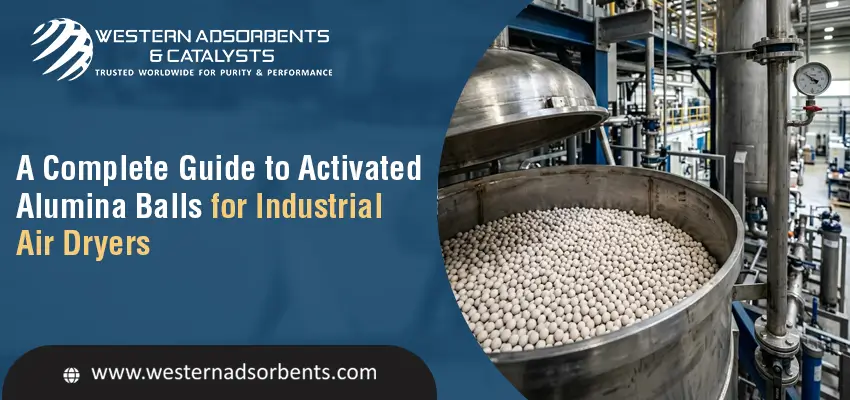
In air compression systems, moisture is the main culprit. Trapped moisture leads to corrosion of pipelines, damages equipment, contaminates products and disrupts manufacturing processes. Industries rely on high-quality activated alumina balls for moisture removal in air dryer systems. It is one of the most effective and economical desiccants used in industries including pharmaceutical, food & beverages, petrochemical plants and water treatment facilities.
Understanding Activated Alumina Balls
Activated alumina balls are highly porous spherical balls made of aluminium oxide. It undergoes a controlled activation process to impart an exceptionally large surface area and adsorption capabilities. Their unique structure makes activated alumina balls ideal for drying gases and liquids without getting saturated or leaking moisture back into the system. At Western Adsorbents & Catalysts, as a top activated alumina balls manufacturer in India, we offer high-quality activated alumina balls that allow them to withstand high-pressure and depressurization cycles without breaking or dusting.
Also Read: What is Activated Alumina Balls
Why Moisture in Compressed Air is a Costly Problem?
In precision industries such as pharmaceuticals, food processing, and electronics manufacturing, even trace moisture in the air supply can compromise product quality, invalidate compliance certificates, and trigger costly recalls. In heavy-process sectors like petrochemicals and natural gas, wet air accelerates corrosion in compressors and heat exchangers, with repair costs that dwarf the investment in a quality desiccant.
How Activated Alumina Balls Work in Industrial Dryers?
The mechanism is physical adsorption: water molecules are attracted to and held on the alumina surface through van der Waals forces and hydrogen bonding. As compressed air flows through the desiccant bed, moisture migrates from the airstream into the pore network of the balls. Critically, this is not a chemical reaction; the alumina itself is not consumed, which is why it can be regenerated and reused over many cycles, making it one of the most economical desiccants available.
Types of Industrial Air Dryers That Use Activated Alumina Balls
Many industries rely on activated alumina balls suppliers in India for activated alumina balls. Understanding how each works helps engineers select the correct grade and size of alumina ball for their system.
- Heatless Desicant Air Dryers: The most common configuration. Two identical towers cycle alternately, one drying, one regenerating using a portion of the dried outlet air at atmospheric pressure. No external heat source is required. Simple, reliable, and widely used in compressed air systems across all industries.
- Externally Heated Dryers: The saturated tower is regenerated using externally heated air, typically at 150–200°C. This drives off the adsorbed moisture more completely, restoring a larger proportion of the desiccant's capacity. Heated dryers consume less purge air than heatless units, reducing compressed air losses.
- Blower-Purge Dryers: An integral blower draws in ambient air, heats it, and circulates it through the saturated tower for regeneration, eliminating the need to use dried compressed air as purge gas. This approach is highly energy-efficient for larger flow rates and is favoured in plants where air consumption must be minimised.
Industries That Rely on Activated Alumina Air Drying
- Petrochemicals & Refineries
- Natural Gas Processing
- Pharmaceuticals
- Food & Beverage
- Textiles & Yarn
- Automotive Manufacturing
- HVAC & Refrigeration
- Electronics & Semiconductors
- Fertiliser Plants
- Paint & Coatings
- Power Generation
- Medical & Hospital Air
Why Choose Western Adsorbents & Catalysts Activated Alumina Balls
Western Adsorbents & Catalysts is one of the leading activated alumina balls manufacturers in India, offering consistent quality desiccant balls that meet and exceed international standards.
- Multiple Sizes Available: From 1–3 mm to 8–10 mm, the full size range needed to match any dryer configuration, vessel diameter, or flow specification.
- Consistent Quality: Batch-tested for BET surface area, crush strength, and attrition loss. Every supply meets the specification sheet.
- Global Export Ready: WAC exports activated alumina to clients across Asia, the Middle East, and beyond. Reliable documentation, packaging, and lead times.
Talk to WAC's technical team; we'll help you select the right grade, size, and quantity for your compressed air drying application.
Frequently Asked Questions (FAQs)
1. What dew point can activated alumina balls achieve in industrial air dryers?
Activated alumina balls can reliably bring compressed air dew points down to −40°C (−40°F) in standard heatless dryer configurations. In optimised heated-regeneration or blower-purge systems, dew points as low as −70°C (−100°F) are achievable, making them suitable for demanding pharmaceutical, food processing, and petrochemical applications.
2. How often should activated alumina desiccant be replaced in air dryers?
With proper operation and storage, activated alumina balls typically last 1 to 3 years depending on air quality, temperature, and regeneration cycle frequency. Oil contamination from upstream compressors is the leading cause of premature desiccant failure. Regular dew point monitoring helps identify when replacement is due before process quality is affected.
3. What sizes of activated alumina balls are suitable for air dryers?
The most commonly used sizes for air dryer applications are 3–5 mm and 4–8 mm balls. Smaller balls offer more surface contact area per unit volume but create higher pressure drop through the bed. Larger balls reduce pressure drop but provide less surface area. The right size depends on your system's flow rate, vessel diameter, and acceptable pressure drop. WAC's technical team can advise on the optimal choice for your configuration.
4 What are activated alumina balls used for in industrial air dryers?
Activated alumina balls are used as desiccants to remove moisture from compressed air systems, helping prevent corrosion, equipment damage, and product contamination.
5. How do activated alumina balls work?
Activated alumina balls adsorb water molecules onto their highly porous surface through physical adsorption, efficiently drying compressed air without undergoing chemical changes.
6. What dew point can activated alumina balls achieve?
Activated alumina can achieve dew points of up to -40°C in standard heatless air dryers and as low as -70°C in optimized heated or blower-purge dryer systems.
7. How long do activated alumina balls last?
Under proper operating conditions, activated alumina balls typically last between 1 and 3 years, depending on air quality, contamination levels, and regeneration efficiency.
8. Which industries use activated alumina air dryers?
Industries including pharmaceuticals, food processing, petrochemicals, natural gas processing, automotive manufacturing, electronics, power generation, and healthcare rely on activated alumina desiccants.
9. What size activated alumina balls are best for air dryers?
The most commonly used sizes are 3–5 mm and 4–8 mm. The ideal size depends on system flow rate, vessel dimensions, and pressure drop requirements.
10. Why choose Western Adsorbents & Catalysts activated alumina balls?
Western Adsorbents & Catalysts offers high-quality activated alumina balls with excellent crush strength, low attrition loss, consistent performance, multiple size options, and global export capabilities.