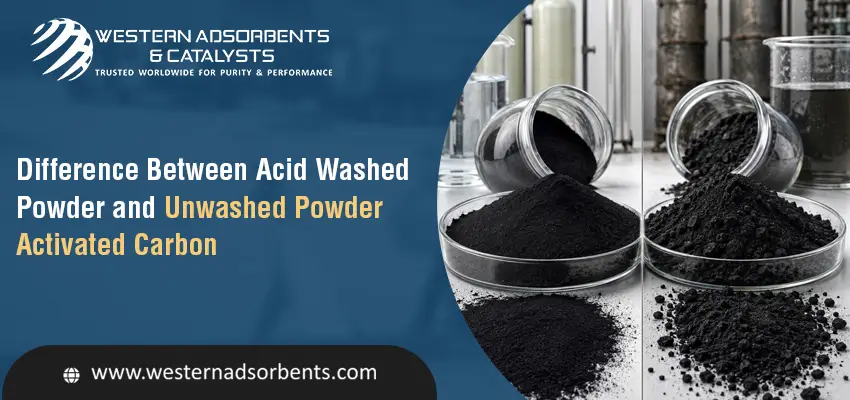
Two bags of powdered activated carbon (PAC) may look identical; both are fine black powders with strong adsorption capacity. But their performance and purity can differ greatly. One of the key differences is often acid washing, an additional treatment step that removes certain inorganic impurities and helps produce a higher-purity carbon. This can make acid-washed PAC more suitable for sensitive applications such as food processing, pharmaceutical manufacturing, and edible-oil purification. If you are selecting powdered activated carbon and are unsure whether you need acid-washed or standard unwashed PAC, this guide explains the key differences, why acid washing matters, and how to choose the right grade for your application.
Acid Washed Powder Vs. Unwashed Powder Activated Carbon: Where the Difference Begins
Activated carbon can be made from different raw materials, including coconut shell, wood, and coal. These materials are activated to create the large internal pore structure that gives activated carbon its adsorption capacity. The carbon is then processed and milled into a fine powder for PAC applications. However, the activation process does not remove all the naturally occurring minerals from the raw material. Some remain behind as ash. For example, high ash content may:
➤ Increase the carbon's pH.
➤ Introduce unwanted metal impurities into the process
➤ Increase the level of soluble inorganic matter
➤ Occupy part of the pore structure and reduce the surface available for adsorption.
This is where the key difference between acid-washed and unwashed PAC begins. The activated carbon manufacturers in world uses acid washing to reduce certain inorganic impurities and produce a cleaner, higher-purity activated carbon for applications where purity is especially important.
What is Acid Unwashed Powder Activated Carbon?
Unwashed PAC is activated carbon that has been activated and milled into powder without undergoing an additional acid-washing or purification step. As a result, it retains more of the naturally occurring ash and mineral content from its raw material. This does not mean unwashed PAC is poor quality. For many industrial applications, it provides the required adsorption performance at a more economical cost.
What is Washed Powder Activated Carbon?
Acid-washed PAC goes through an additional purification step after activation. The carbon is treated with an acid, commonly hydrochloric acid (HCl), to dissolve and remove certain inorganic minerals and soluble metals present in the ash. After acid treatment, the carbon is thoroughly washed to remove the dissolved impurities and any remaining acid before it is processed for use.
Acid Washed Powder Vs. Unwashed Powder Activated Carbon: Differences at a Glance
| Property | Unwashed PAC | Acid Washed PAC |
| Processing | Activated & milled | Additional acid treatment & rinse |
| Ash content | Higher | Significantly lower |
| Iron & heavy metals | Higher residual levels | Greatly reduced |
| Leachable impurities | More | Few |
| pH | Often alkaline | Lower/more neutral |
| Purity | General-purpose | High-purity |
| Cost | Lower | Higher |
Why Acid Washing Improves More Than Just Purity
At Western Adsorbents & Catalysts, a trusted activated carbon manufacturer in India, we emphasise that acid washing is often thought of purely as a cleanliness step, but it affects performance in three practical ways:
➤ It Helps Reduce Contamination and Leaching: Acid washing removes soluble metals and inorganic minerals that could otherwise leach into the treated product. This is particularly important when activated carbon comes into contact with food, pharmaceuticals, edible oils, or other products with strict purity requirements.
➤ It Provides Better pH Control: The mineral ash in unwashed carbon can contribute to a more alkaline pH. By reducing this ash, acid-washed PAC offers a lower and more controlled pH, helping minimise unwanted changes to sensitive process streams.
➤ It Can Improve Access to the Pore Structure: Mineral deposits and ash can occupy or partially block some pores. Removing these inorganic materials can help expose more of the carbon's pore network. In certain applications, this may contribute to more consistent and efficient adsorption.
Which Grade Does Your Application Need?
The choice is driven almost entirely by how sensitive your product is to inorganic impurities.
Choose Acid-washed PAC for:
➤ Pharmaceutical and API purification
➤ Food and beverage processing
➤ Edible oil refining and decolourisation
➤ Sweeteners, glucose, and sugar syrups
➤ Cosmetics and personal care
➤ High-purity chemicals and catalyst supports
Choose unwashed PAC for:
➤ Municipal and industrial water and wastewater treatment
➤ Effluent and general decolourisation
➤ Air and gas odour control
➤ Other industrial uses where trace inorganic content is not a concern
Match the Carbon to Your Process With Western Adsorbents & Catalysts
Acid-washed and unwashed powdered activated carbon are not simply better and lower versions of the same product. They are different grades designed for different process and purity requirements. The right choice depends on the level of impurity control your application demands. Choosing the appropriate grade means getting the purity and adsorption performance you need without paying for processing that your application does not require.
As an activated carbon supplier in India, Western Adsorbents & Catalysts supplies both standard and acid-washed powdered activated carbon for a wide range of applications, including water treatment, edible oil refining, food and beverage processing, and pharmaceutical manufacturing. Not sure whether your process requires standard or acid-washed PAC? Talk to the Western Adsorbents team today.